Set on the banks of the Sava River in Belgrade, Serbia, the site of a former cement factory became the starting point for the 21st edition of the Saint-Gobain Architecture Student Contest. Organized in cooperation with the World Green Building Council, OneClick LCA, the City of Belgrade, the Academic Yachting Club Belgrade, the Serbia Green Building Council, and the Green & Blue Corridors Association, invited students to imagine a new Sports and Recreation Hub capable of transforming an industrial waterfront into a year-round public destination. More than 200 universities from 34 countries participated in this 21stedition of the Architecture Student Contest.
The third episode of the Room For Dreams podcast confronts one of the most pressing dilemmas in modern urban planning: how to breathe in new life into old structures without erasing their history. Recorded live at Milan Design Week 2026 in cooperation with INDX|GLOBAL, this dynamic session gathers a panel of architects — Kiran Gala, Vivek Gupta, and Carl Bhesania — to unpack the complex realities of adaptive reuse.
Long before it becomes a matter of performance, comfort, or energy efficiency, natural light is a way of giving presence to architecture. It reveals the texture of a wall, the depth of an opening, and the silent passage of time within a space. In works as distinct as those of Tadao Ando and Alvar Aalto, daylight appears as an essential material of design: in some cases, guiding the eye toward contemplation; in others, making spaces feel more human, welcoming, and connected to everyday life.
The second episode of the Room For Dreams podcast series introduces a compelling dive into how architecture can embrace the future without losing its soul. Recorded live at Milan Design Week 2026 in cooperation with INDX|GLOBAL, this episode features architects Arun Sharma and Jaskaran Singh as they unpack the true meaning of the digital vernacular.
At Salone del Mobile 2026, MARA presented its latest collection within a fair-stand concept designed by Italian architect and designer Ferruccio Laviani. Conceived as a micro-abstraction of an arena, the installation placed visitors at the center of an ascending spatial composition, where the brand's newest products were displayed across stepped tiers.
The setting was inspired by the idea of the Greek theatre as a place of encounter, exchange, and collective observation. The stand proposed a kind of architectural landscape in which visitors could sit, move through the space, observe the objects from different angles, and engage with the brand in a more direct and experiential way.
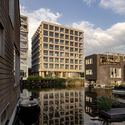
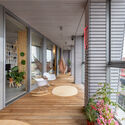
With forty-eight psychogeriatric beds and sixty-eight wheelchair-accessible apartments, accommodation for informal caregivers, and space for bedside care, the De Keyzer building opened in Amsterdam in 2011. Its program had been conceived entirely for elderly people requiring assistance, but shortly after completion, the building was sold to an investment fund, and the apartments began to be rented to young families with children.
For the project's architects, Tom Frantzen and Karel van Eijken, the episode could have been interpreted as a failure of prediction. Instead, it became a confirmation. "It showed, very clearly, that buildings can end up being used in completely different ways than originally intended," Frantzen recalls. The transformation was only possible because the apartments were generous and because the structure allowed for uses more diverse than those anticipated in the original program. Had the building been designed solely for its initial function, the change of use would likely have required a destructive renovation or, in the extreme, demolition.
The premier episode of the Room For Dreams podcast series, produced in collaboration with INDX|GLOBAL, features an engaging panel discussion centered on materializing the future through the lens of Indian architecture and design. Recorded live at Milan Design Week 2026 and moderated by Claire Broadka of designboom, the conversation brings together three visionary architects: Rachna Agarwal, custodian of Studio IAAD and Zoera; Vaibhav Dimri, founding partner of Anagram Architects; and Dinesh Panwar of Urbanscape Architects.
Moving from the drafting table to the computer screen, the digitization of drawings and documentation marked the first phase of digital transformation in architecture firms. The second introduced BIM, connecting project information through cloud platforms and collaborative workflows. Nowadays, a new phase is emerging, defined by artificial intelligence, automation, and more specialized software ecosystems. The paradox is that while previous phases were dominated by a small number of tools, today's landscape offers an abundance of highly specialized, AI-enabled, and often overlapping solutions competing for attention. While purchasing new software is often the easiest part of digital transformation, the greater challenge lies in changing established workflows and behaviors, which is why many new tools struggle to achieve lasting adoption.
Produced on an industrial scale since the 19th century, steel has profoundly transformed the way we build. Iron, refined through controlled metallurgical processes, has given rise to a material capable of combining mechanical strength, relative lightness, and constructive precision, making possible some of the major achievements of modern engineering and architecture. From skyscrapers and bridges to facades, roofs, and industrialized systems, few materials have had such a significant impact on shaping the built environment.
However, the quality of a material cannot be measured solely by its initial structural performance or its appearance at the time of delivery. Although buildings are often evaluated when they are completed, their true performance only reveals itself over time. Photographs record impeccable facades, newly installed surfaces, and spaces ready for use. The following decades, however, expose these constructions to solar radiation, rain, humidity, salinity, air pollution, and thermal variations. It is in this continuous contact with the environment that material choices are effectively put to the test.
Unlike many other activities that now take place entirely in digital environments, the final result of work in the architecture, engineering, and construction industry does not remain on a screen. Files become buildings, models transform into structures, and decisions made during the design process ultimately shape streets, neighborhoods, and entire cities. A building often lasts for decades, sometimes centuries, and the impacts of the choices made during its development extend far beyond the moment of delivery, influencing the daily lives of thousands of people.
Between the moment a material is specified in a project and the moment it is installed, there is an invisible layer that plays a decisive role in the final outcome: fabrication, logistics, and coordination. These factors shape timelines and costs, but more critically, determine whether the original design intent is preserved or diluted in execution. Cladding systems, especially those that function as visible and expressive components of the building envelope, make this gap particularly evident, as they are the most outward-facing layer of a project.
Selecting a cladding system is never a purely aesthetic decision. It activates a chain of dependencies: profile availability, fixing systems, tolerances, sequencing, and compliance with local codes. When elements are misaligned, the fallout is rarely subtle. Integrated cladding systems—those that anticipate assembly as much as appearance—tend to close this gap, embedding coordination into their logic and reducing the need for on-site improvisation.
Architectural schools usually leave lasting marks on their students, shaping their style and critical inquiry long after formal education has ended. For example, SCI-Arc, founded in 1972 and based in downtown Los Angeles, is an institution recognized for its culture of experimentation, critical investigation, and creative independence, building a reputation based on the idea that architecture should be understood as a field open to dialogue with art, technology, design, and contemporary culture. The diversity of trajectories of its alumni demonstrates how this environment can generate distinct professional approaches, but united by the same willingness to explore new possibilities.
Architecture has always depended on systems of representation to make ideas visible before they exist. But where Filippo Brunelleschi's fifteenth-century linear perspective once organized space according to human perception, today's architects face an unprecedented saturation of imagery. AI generates atmospheres in seconds, and projects circulate continuously long before construction begins. But the abundance of images does not necessarily produce greater clarity and as architectural workflows become faster and more fragmented, visuals sometimes circulate detached from the decisions, constraints, and intentions that generated them. The real value of modern visualization is no longer just about rendering a final image—it is about how design and visual communication are understood collectively throughout the entire process.
Traditional building solutions tend to work well in their respective contexts, as they have withstood hundreds of years of testing and improvements, and use techniques and materials available locally. Although globalization and the democratization of access to technology have brought more comfort and new opportunities to humanity, it has also led to the homogenization of solutions in the construction sector and a dependence on global supply chains for construction materials and components. This has also caused a rupture in how knowledge is passed on to new generations and, eventually, the disappearance of traditions.
In particular, the topic of passive cooling solutions for buildings is currently having a resurgence, with an effort to recover ancient techniques used throughout history in locations that have always had to deal with hot climates. This is even more evident due to the high energy costs imposed by artificial cooling, the global warming scenario, and mainly because, among the projections of population growth, a significant portion of megacities will be located in the predominantly hot climates of Africa and Asia. When we think about the future, is it possible to be inspired by the past and apply ancient cooling techniques to contemporary buildings?
Culinary Health Fund . Image Courtesy of Longboard
Before we rationally understand a space, we perceive it sensorially. Light, proportion, texture, color, and materiality all influence how the body interprets an environment, shaping whether it feels welcoming, cold, intimate, or impersonal. Visual and chromatic elements can directly affect the perception of depth, atmosphere, and scale within interiors, particularly in contemporary buildings characterized by large spans and continuous surfaces. Among the architectural elements that shape this experience, the ceiling may be one of the most underestimated, despite its profound influence on how space is perceived and inhabited.
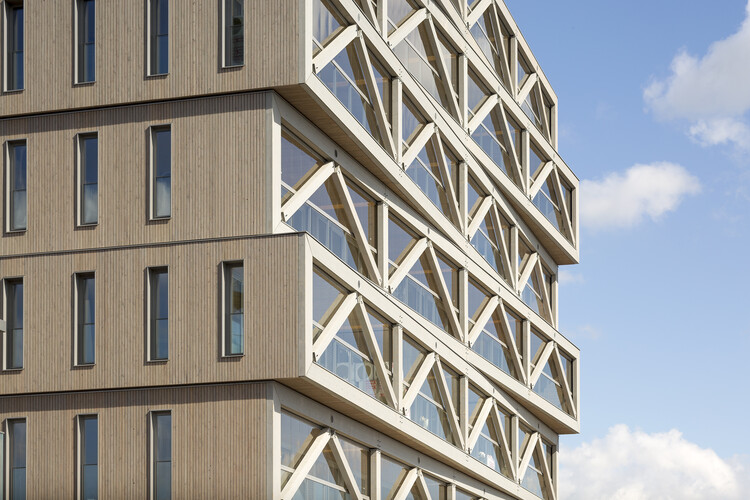
Mass timber has shifted from an experimental niche to a central part of the contemporary debate surrounding sustainable construction. The combination of lower embodied carbon, prefabricated systems, and faster construction timelines has helped position solutions such as CLT (cross-laminated timber) and DLT (dowel-laminated timber) as viable alternatives to concrete and steel in residential buildings, offices, schools, and public facilities around the world. Added to this are the predictability of construction processes and the environmental qualities associated with wood, often linked to user comfort and spatial experience.
Workplace ergonomics have long been defined by stability: fixed postures, lumbar support, carefully calculated angles, and the relentless pursuit of the "correct" way to sit. Comfort was largely associated with maintaining a supported posture in chairs designed to reduce movement, align the spine, and sustain the body during long periods of sitting. Today, as contemporary workspaces become increasingly flexible and hybrid, questions are emerging around whether comfort is truly linked to static permanence, or rather to the possibility of movement itself.
Although ergonomic chairs have evolved significantly, many still operate within a "corrective" logic, managing discomfort through mechanisms and adjustments without fundamentally reconsidering the relationship between the body and motion. Recent research on sedentary behavior and active ergonomics has challenged the idea of stillness as the ideal condition for comfort. Instead, subtle posture transitions and continuous micro-movements are now understood as important contributors to circulation, musculoskeletal health, and overall wellbeing. In this context, contemporary ergonomics gradually begins shifting away from models based on containment toward approaches centered on adaptability, balance, and fluid movement.
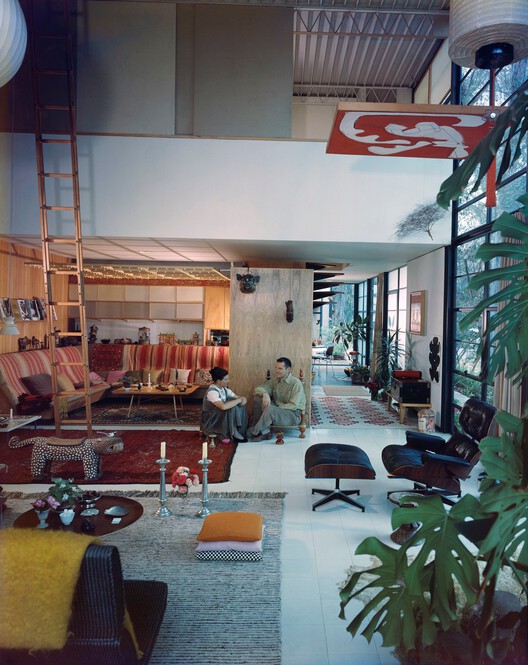
Sitting on low benches, casually talking, dressed in comfortable clothes, and surrounded by books, design objects, and works of art, Charles and Ray Eames appear in one of the most emblematic images of postwar modern domesticity in the United States. The house does not appear as an explicit architectural manifesto, but rather as an inhabited, appropriated, everyday space. Still, nearly everything in that scene functions as the condensation of a carefully constructed ideal: modern informality, the integration between architecture and daily life with the coexistence of industrial production. The photograph projects a way of living more than it represents a residence. And perhaps that was, from the very beginning, the central ambition behind the Case Study Houses.