
Eran Chen

BROWSE ALL FROM THIS AUTHOR HERE

Form Follows Fun: The New Paradigm

Subscriber Access | 

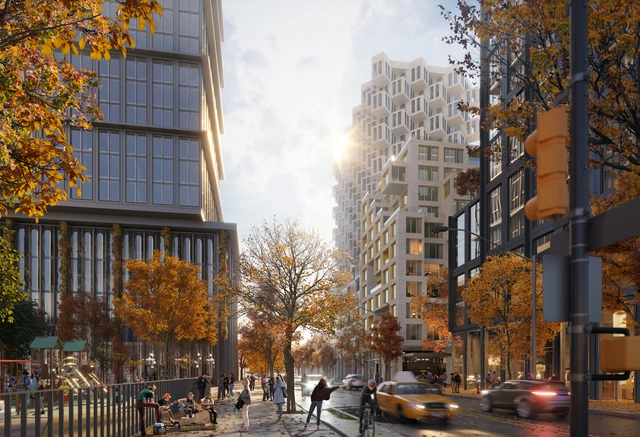
If street culture is the glue that holds together an urban environment, what happens when its denizens no longer need to go outside? This is one of the fundamental questions faced by architects today, decades after the New Urbanist movement first popularized, or rather brought back, the concept of mixed-use streetscapes—and more than sixty years since Jane Jacobs famously championed walkable streets as essential to building vibrant urban communities.

Long gone, of course, are the days when city streets were our only outlet or option for access to retail and other services. Now, the internet gives us all that and more: remote shopping, banking, education, and even healthcare. Meanwhile, social media has transformed the way we communicate with friends and neighbors. All of which is to say: we no longer need to go out for social interaction or to procure services, we choose to.

Form Follows Fun: The New Paradigm - Image 1 of 4Form Follows Fun: The New Paradigm - Image 2 of 4Form Follows Fun: The New Paradigm - Image 3 of 4Form Follows Fun: The New Paradigm - Image 4 of 4Form Follows Fun: The New Paradigm - More Images+ 4

Collectivity and the Common Good: How Housing Will Change Thanks to Coronavirus

Subscriber Access | 
Collectivity and the Common Good: How Housing Will Change Thanks to Coronavirus - Featured Image
First © Imagen Subliminal. Image Courtesy of ODA Architecture

Humanity is facing a collective new challenge unprecedented in our lifetime. One of isolation, driven by self-quarantine, for a period unknown. It is a social experiment with no predictable outcome. But one constant in the equation is architecture.

With over half the world’s population inhabiting cities or densely populated areas, billions of people are currently residing in small spaces, disconnected from one another by brick, concrete and steel. The social housing experiment of the 1950s and 60s created a new architectural typology, which was compounded by an underlying social construct, driven by capitalism, that told us to mind our own business. Somehow, during the age of high rises that followed, turned this idea of isolation into a status symbol, as private penthouses, accessed by private elevators, today float high above the city streets.