1. ArchDaily
  2. 3D Printing

3D Printing: The Latest Architecture and News

The Digital Divide: Can Technology Support Vernacular Architecture?

The architecture and construction industry has undergone a transformation with the integration of various digital tools, now indispensable to the design process. The welcoming of technologies has effectively streamlined operations, enhanced efficiency, and elevated design quality. This digital shift, however, has resulted in a digital divide that goes beyond accessibility to tools and software. It also encompasses the crucial aspect of integrating traditional and indigenous communities into the urban development landscape. Can advancing technology support the growth of vernacular architecture? Can indigenous building practices find a place in the vision for a digitalized future?

The Digital Divide: Can Technology Support Vernacular Architecture? - Image 1 of 4The Digital Divide: Can Technology Support Vernacular Architecture? - Image 2 of 4The Digital Divide: Can Technology Support Vernacular Architecture? - Image 3 of 4The Digital Divide: Can Technology Support Vernacular Architecture? - Image 4 of 4The Digital Divide: Can Technology Support Vernacular Architecture? - More Images+ 1

Tideland Studio Applies Architectural Technologies to Create a Sensorial Understanding of Environmental Changes

While it is undeniable that the surrounding environment is changing due to human activity, the effects can be difficult to perceive directly, as they are often illustrated with unrelatable pictures of far-away places or overused graphics and statistics. Danish office Tideland Studio aims to change this. Through their work, they aim to bring forth a new type of sensible understanding of the changes happening around us. They work across disciplines, melding research, art, and architecture while employing the newest survey and fabrication technologies to give presence to the abstract phenomena that shape our planet. Because of their practical approach to research and the new perspectives that they open toward extreme environments affected by climate change, ArchDaily has selected Tideland Studio as one of the 2023 New Practices. The annual survey highlights emerging offices that use innovation and forward-looking processes to rethink the ways in which we practice architecture.

Tideland Studio Applies Architectural Technologies to Create a Sensorial Understanding of Environmental Changes - Image 1 of 4Tideland Studio Applies Architectural Technologies to Create a Sensorial Understanding of Environmental Changes - Image 2 of 4Tideland Studio Applies Architectural Technologies to Create a Sensorial Understanding of Environmental Changes - Image 3 of 4Tideland Studio Applies Architectural Technologies to Create a Sensorial Understanding of Environmental Changes - Image 4 of 4Tideland Studio Applies Architectural Technologies to Create a Sensorial Understanding of Environmental Changes - More Images+ 8

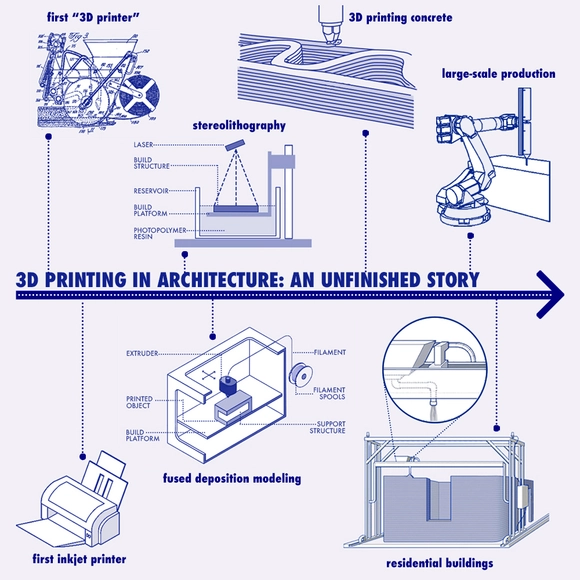
Infographic: The Evolution of 3D Printing in Architecture, Since 1939

Subscriber Access | 

For many years, often spoken in tones of anticipation and excitement, we have heard that 3D printing will revolutionize the architecture industry as we know it. But if we stop for a moment, reflect on the present and look back at the past, it becomes evident that the technology has long been reshaping the field, continuously undergoing profound transformations and ushering in new eras of design, construction and spatial creativity. Operating as a layer-by-layer additive manufacturing process, 3D printing uses digital models to create customized three-dimensional objects with a remarkable level of precision and efficiency, saving time, generating zero waste, reducing labor costs and opening avenues for rapid prototyping and iterative design. It enables architects to explore creative opportunities and regain autonomy by designing complex, non-standardized elements within an industrial and mass-customized process.

Infographic: The Evolution of 3D  Printing in Architecture, Since 1939 - Image 1 of 4Infographic: The Evolution of 3D  Printing in Architecture, Since 1939 - Image 6 of 4Infographic: The Evolution of 3D  Printing in Architecture, Since 1939 - Image 5 of 4Infographic: The Evolution of 3D  Printing in Architecture, Since 1939 - Image 4 of 4