"There is no space without event, no architecture without action." When Bernard Tschumi wrote these words, he was articulating a fundamental principle of the architect's practice. Architecture is about behavior. Every stroke of a pen on a floor plan is a proposition about how occupants will move or what actions become possible.
To draw is to architect a reality. Though with this power, architecture does not command. It does not issue instructions or enforce compliance, but it operates through a soft control — a mode of influence that shapes behavior by structuring perception and guiding attention.
In 1962, the architect Buckminster Fuller envisioned a floating city that would free humanity from its dependence on the Earth. The speculative project consisted of enormous geodesic spheres that would naturally levitate in air warmed by the sun and be anchored to mountaintops. Designed to house thousands of people, Fuller’s Cloud Nine aimed to ease land ownership pressures, address housing shortages, and contribute to environmental preservation.
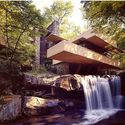
More than half a century later, we remain far from realizing Fuller’s vision. Creating a truly floating structure on the Earth’s surface is still, for now, an unattainable ideal. While supports continue to be necessary, we manipulate their position, intensity, and number, developing structural “acrobatics” to at least approach the idea of overcoming gravity — a desire that has long fascinated humanity.
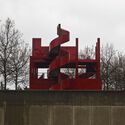
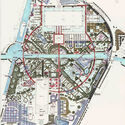
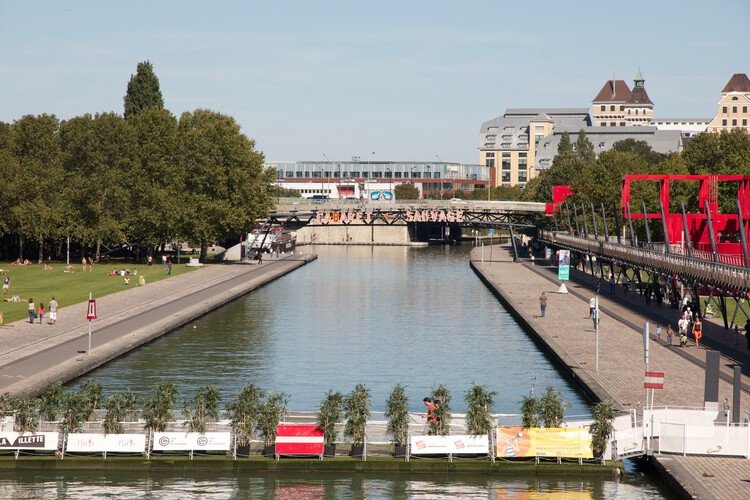
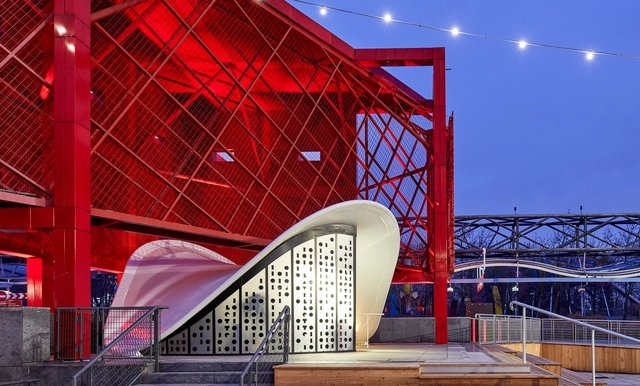
Paris's 19th arrondissement Parc de la Villette is undergoing a major transformation, combining a newly opened urban farm with restored biodiversity as part of a strategy to adapt the 55.5-hectare park to climate change. Masterplanned by Bernard Tschumi in 1982 and opened to the public in 1987, the park stands as a landmark of European modernism in public space design, breaking from the traditional concept of the metropolitan park. With a 15,000-square-meter extension, this major green lung in northeast Paris is reimagining its lawns as a living laboratory for environmental education, where animals, plants, and humans coexist. The extensive renovation follows the addition of Tschumi's HyperTent in 2022, a hyperbolic paraboloid structure functioning as a new ticket booth on the podium of Folie L4, and marks the park's most significant transformation since its inauguration.
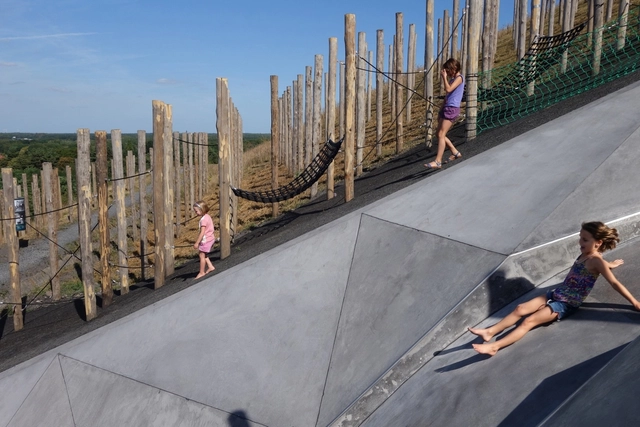
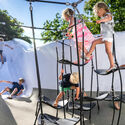
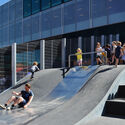
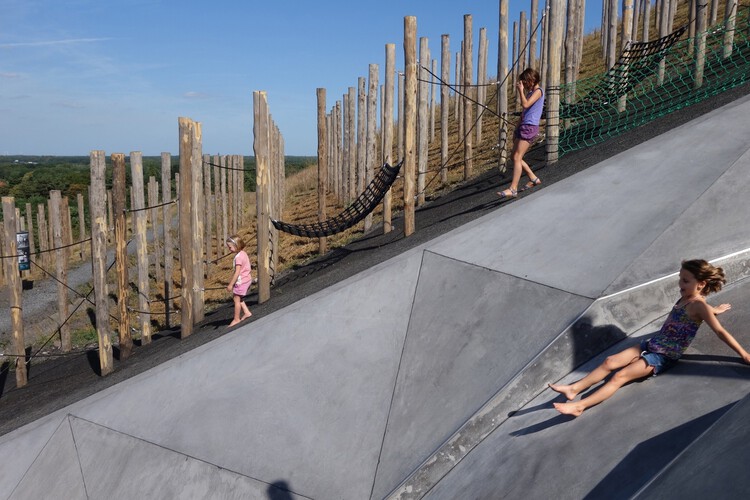
Play Landscape be-MINE / Carve + OMGEVING. Image Courtesy of Carve
Playgrounds are spatial instruments through which society projects its expectations on childhood, testing the boundaries between control and autonomy, exposure and protection. They regulate how children relate to space, to others, and their bodies — encoding, often invisibly, social norms, fears, and aspirations. In this sense, playgrounds are not peripheral spaces of leisure; they are political constructs shaped by specific ideologies about what childhood is and how it should unfold. Since 1989, the right to play has been formally recognised in the United Nations Convention on the Rights of the Child, affirming that play is a fundamental part of human development. To design a playground is not only to draw lines on a plan or to install equipment in a park; it is to define the conditions under which play is permitted, imagined, or constrained.
Public space has long been central to architectural thought, often framed in terms of planning, infrastructure, and regulation. From Haussmann's Paris to contemporary masterplans, architects have worked to define and formalise collective life through spatial tools. Yet, outside of these frameworks, artists have continuously offered alternative ways of understanding and inhabiting public space—ways that rely not on construction or permanence, but on presence, perception, and participation. Through actions, objects, or atmospheres, artists engage the city as a site of friction and imagination. These gestures challenge architectural conventions and invite artists to reconsider public space not as a solved form, but as a contingent and open process.
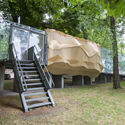
Bernard Tschumi's HyperTent, a hyperbolic paraboloid structure, is the latest addition to the iconic Parc de la Villette. Prompted by the opening of L'Espace Chapiteaux, a space for contemporary circus performances, the new ticket booth located on the podium of Folie L4, originally a music venue, carefully negotiates its presence within the context. The morphology of the project allows for the two structures to coexist without interfering. At the same time, the materiality of the HyperTent makes for an iconic presence in juxtaposition with the adjacent folie.
This week, with the help of our readers, our Architecture City Guide is headed to Paris. For centuries Paris has been the laboratory where innovative architects and artists have come to test their ideas. This has created a city that has bit of everything. Where the architecture of some cities seems to undergo phases of punctuated equilibrium, Paris’s architectural fossil record gives an impression of gradualism; all the missing links are there. This makes it easy to trace the origins of the most contemporary ideas throughout history. Nothing seems to come out of nowhere. If you look around you kind find the design’s inspiration running through the city’s Roman, Medieval, Renaissance, Baroque, Classical, Rocco, Neo-Classical, Empire, Art Nouveau, Art Deco, Modern, Post-Modern, and Contemporary Architecture. Seen in another context, many of Paris’s buildings might seem out of place, but the bones of this city support the newest iterations on the oldest and most profound questions. The 24 contemporary designs that comprise our list probably should not be viewed outside of this context, even though that is the stated goal of some of the designs.
As the most visited city in the world and arguably the capital of culture, it is impossible to capture the essence of Paris in 24 modern/contemporary designs. Our readers supplied us with great suggestions, and we really appreciate the help and use of their photographs. The list is far from complete and we realize that many iconic buildings are not yet on the list. We will be adding to it in the near feature, so please add more in the comments section below.