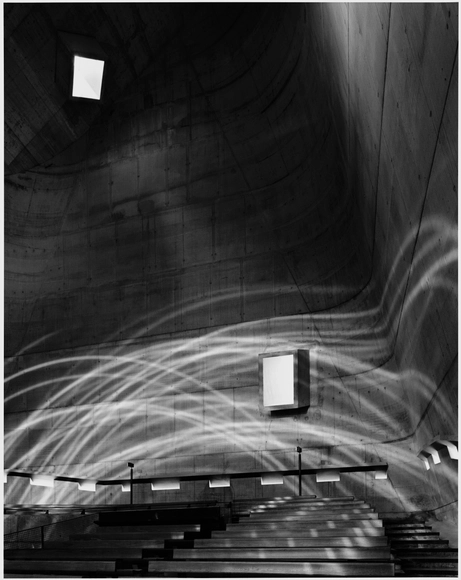
In the wake of her selection as the recipient of the Julius Shulman Institute Excellence in Photography Award for 2015, Hélène Binet's work will be exhibited at the Woodbury University Hollywood (WUHO) Gallery in Los Angeles, California. The exhibition, entitled Hélène Binet: Fragments of Light, will be open from February 28, 2015 to March 29, 2015, showcasing the highlights of the artist's career as a renowned architectural photographer. The exhibition will be initiated with an opening reception and award ceremony on February 28, 2015 to honor Binet for her achievements.
64 North, HNTB Engineering, Bionic Landscape Architecture and sculptor Ned Kahn have been chosen by the City of Palo Alto to realized a new bicycle and pedestrian bridge over the 14-lane Highway 101 at Adobe Creek. Their winning proposal, “Confluence” will connect residential and commercial areas in south Palo Alto to the Baylands Nature Preserve and the regional Bay Trail network.
Read on for more information and a video about the design.
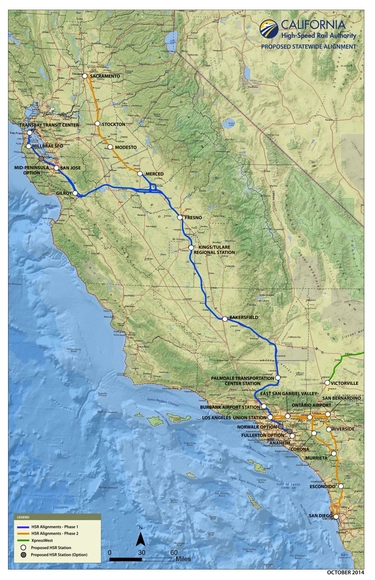
Proposed Statewide Alignment Map. Image Courtesy of Rail LA
California has broke ground on America’s first high-speed rail line in Fresno, six years after voters first approved an almost $10 billion bond act to fund the project. However, along with celebrations comes skepticism; according to an NPR report, fears of the project’s failure have risen due to the rail line only having a fifth of its funding and that its nearly three-hour journey will still take longer than a flight connecting Los Angeles to San Francisco. Despite this, supporters are optimistic that the line will be up and running by 2030. The state will be relying on private investment and revenue from the state’s greenhouse-gas fees to secure the remaining $55 billion needed to complete the $68 billion project.
We all know that in architecture, few things are truly original. Architects take inspiration from all around them, often taking ideas from the designs of others to reinterpret them in their own work. However, it's more rare that a single architectural element can be borrowed to define the style of an entire region. As uncovered in this article, originally published by Curbed as "Le Corbusier's Forgotten Design: SoCal's Iconic Butterfly Roof," this is exactly what happened to Le Corbusier, who - despite only completing one building in the US - still had a significant impact on the appearance of the West Coast.
Atop thousands of homes in the warm western regions of the United States are roofs that turn the traditional housetop silhouette on its head. Two panels meet in the middle of the roofline and slope upward and outward, like butterfly wings in mid-flap. This similarity gave the "butterfly roof" its name, and it is a distinct feature of post-war American residential and commercial architecture. In Hawaii, Southern California, and other sun-drenched places, the butterfly roofs made way for high windows that let in natural light. Homes topped with butterfly roofs seemed larger and more inviting.
Credit for the butterfly roof design often goes to architect William Krisel. He began building single-family homes with butterfly rooflines for the Alexander Construction Company, a father-son development team, in Palm Springs, California, in 1957. The Alexander Construction Company, mostly using Krisel's designs, built over 2,500 tract homes in the desert. These homes, and their roofs, shaped the desert community, and soon other architects and developers began building them, too—the popularity of Krisel's Palm Springs work led to commissions building over 30,000 homes in the Southland from San Diego to the San Fernando Valley.
The final exterior scaffolding has been removed from Diller Scofidio + Renfro’s “The Broad” in downtown Los Angeles, revealing its distinctive honeycomb-like “veil.” Comprised of 2,500 fiberglass reinforced concrete panels and 650 tons of steel, the structural exoskeleton “drapes” over the building’s interior “vault,” lifting at its south and north corners to provide two street-level entrances. At its side, the veil is torn by a central “oculus” that provides a direct visual connection between the museum and Grand Avenue.
“The Broad will be porous and absorptive, channeling light into its public spaces and galleries. The veil will play a role in the urbanization of Grand Avenue by activating two-way views that connect the museum and the street,” described Liz Diller.
The first week of December marked the beginning of the LA Philharmonic’s in/SIGHT concert series. The multimedia series will incorporate video images playing in sync with the performance, creating an immersive new way to experience the music for concert-goers. The first of these performances was the collaborative work of conductor Esa-pekka Salonen and artist Refik Anadol in an audio-visual rendition of Edgard Varèse’s Amériques. Using audio analysis and Kinect motion capture software to record Salonen’s movements while conducting, Anadol has created a stunning set of moving images that capture the very spirit of Varèse’s work. Learn more about this fascinating project, after the break.
Ehrlich Architects, a Los Angeles-based practice dedicated to the philosophy of Multicultural Modernism, has been selected to receive the American Institute of Architects (AIA) 2015 AIA Architecture Firm Award. The award celebrates Ehrlich Architects' 35 years of practice, which, as the AIA notes, has become renowned for “fluidly melding classic California Modernist style with multicultural and vernacular design elements by including marginalized design languages and traditions.”
The firm, originally founded by Steven Ehrlich in 1979 after working with the Peace Corps in Africa, is now led by four diverse partners: Ehrlich, alongside Takashi Yanai, Patricia Rhee, and Mathew Chaney. You can preview some of their most notable projects and watch an interview with Ehrlich, after the break.
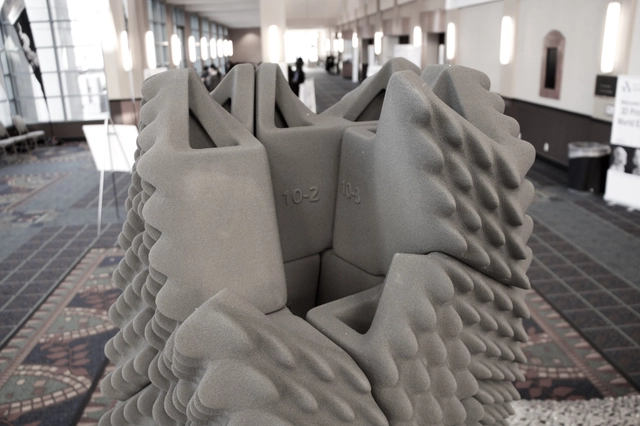
A team of California-based designers have invented an earthquake-proof column built of 3D printed sand, assembled without bricks and mortar to withstand the harshest seismic activity. The 'Quake Column' is comprised of a pre-determined formation of stackable hollow bricks which combine to create a twisting structure, optimized for intense vibrations in zones of earthquake activity. Created by design firm Emerging Objects, the column's sand-based composition is one of many in a series of experimental structures devised by the team using new materials for 3D Printing, including salt, nylon, and chocolate. The column can be easily assembled and disassembled for use in temporary and permanent structures, and was designed purposefully with a simple assembly procedure for novice builders.
Find out how the Quake Column works after the break
In 1989, California's central coast was rocked by a 6.9 magnitude earthquake, destroying infrastructure and buildings in San Francisco, Oakland, and a host of coastal cities. The Loma Prieta Earthquake caused an estimated $6 trillion in damage, prompting researchers to develop techniques for management of severe seismic activity in urban centres. Twenty five years later, a team of engineers at Stanford University have invented a cost-effective foundation for residential buildings capable of withstanding three times the magnitude of the catastrophic 1989 earthquake.
Find out more on Stanford's earthquake-resistant technology after the break
Update:The Los Angeles County Metropolitan Transportation Authority Board of Directors has approved approved the proposed masterplan by Grimshaw and Gruen; the scheme will now go ahead, subject to the availability of funding. The below article is from 22 September 2014.
The New York office of Grimshaw and LA based Gruen Associates were officially awarded the Los Angeles Union Station master plan in July of 2012 after six initial proposals for the project. Now the Metro Board has begun to finalize plans and move towards implementation, with their Planning Committee scheduled to discuss the proposals in early November. Read on to learn more about how the plan has developed over the past two years and the next steps towards its implementation.
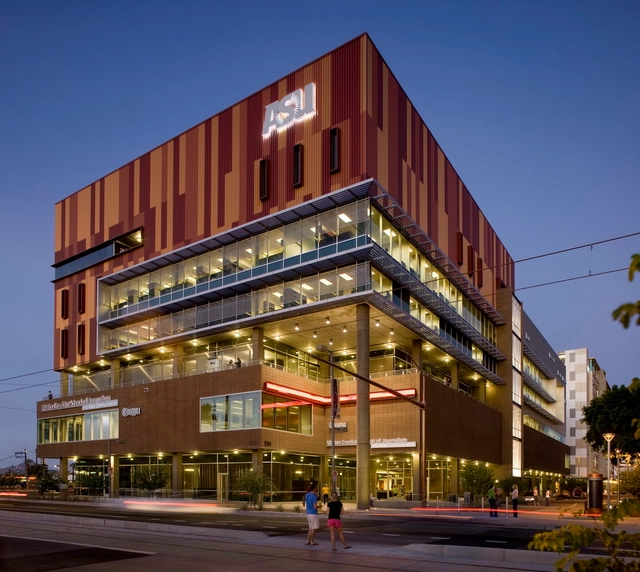
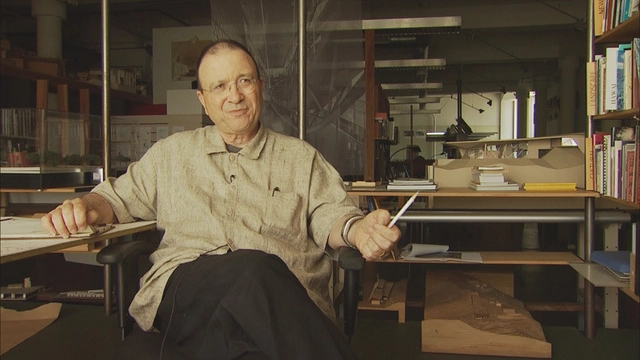
Michael Rotondi, principle of Los Angeles-based RoTo Architecture and former student of Cal Poly Pomona, has been selected to receive the Richard J. Neutra Medal for Professional Excellence from the College of Environmental Design at the California State Polytechnic University, Pomona. Co-founder of SCI-Arc and long-time architectural educator at Arizona State University, Rotondi was selected for his “commitment to architectural education, for the concern he shows in his work for society and the environment, and for the inventiveness of his architecture,” says Cal Poly Pomona professor Sarah Lorenzen.
As part of NOWNESS’ latest In Residence series, American architect Ray Kappe takes you on a tour through his glass and redwood “treehouse” on Los Angeles’ Rustic Canyon hillside. Built some 50 years ago, the house is considered to be one of the greatest modern residences in Southern California.
Breaking New Groundis an international design and ideas competition addressing the urgent affordable housing needs for farmworker and service worker families in the Coachella Valley, where efforts to improve living conditions suffers from a lack of funding and coordination. Going beyond design, the competition seeks to envision new precedents, mechanisms, and policies for affordable housing implementation and development, with implications for California and the nation.
At the competition’s conclusion, The California Endowment and County of Riverside will work together to build an affordable housing project based on the winning entries. The winning team may also be selected to participate in the design and construction of the new project.
Helicopter landing pads will no longer be required atop new buildings in Los Angeles, California. The rule’s elimination, which was announced yesterday by the city’s mayor and fire chief, allows architects the freedom to break away from LA’s “boxy” skyline. “I want to see innovative design,” Mayor Eric Garcetti said. “I want to see good design, but we’re going to take the handcuffs off of you when we ask you to do that. I want neighborhoods to look good, and I want our buildings to look iconic.” You can read more about the change, here.
Michael Maltzan, Frederick Fisher, Predock Frane, MAD and Leong Leong have been shortlisted in a limited competition to design a new Los Angeles LGBT Center (formerly called LA Gay and Lesbian Center). Each have received a stipend of $20,000 to develop proposals for the new campus, which will include arts, educational and affordable housing programs on more than an entire city block in Hollywood. Once complete, the center hopes to serve LGBT community members of all ages by providing access to multigenerational affordable housing, healthcare, senior care and family services. You can learn more on KCRW here.
The Southern California Institute of Architecture (SCI-Arc) has appointed Hernan Diaz Alonso as the Los Angeles architecture school’s new Director beginning September 2015. Alonso, principal of Xefirotarch and educator widely credited for spearheading the transition of SCI-Arc to digital technologies, will succeed architect Eric Owen Moss who has served as the school’s director since 2002. Continue after the break to watch Alonso’s “New Director Presentation” and preview a selection of his work.
The San Francisco Museum of Modern Art has topped out its Snøhetta-designed extension, marking the halfway point in the museum’s transformation. Rising behind SFMOMA’s existing Mario Botta-designed building, the 10-story addition will add more than triple the amount of gallery space, 130,000 square feet of indoor and outdoor galleries, flexible performance art spaces and a dramatically expanded education program for students and teachers upon completion in 2016.
Architecture at Zero Citation Award: NZ + Beyond Net Zero Energy / Drew Adams, Joseph Yau and Mark Alocilja. Image Courtesy of Architecture at Zero
Architecture at Zero, now in its fourth year, is challenging all students, architects and designers worldwide to envision two mixed-use, zero net energy (ZNE) housing proposals for adjacent parcel sites in Oakland, California. The competition is a response to the ZNE targets set out by the California Public Utility Commission (CPUC) which aims for all new residential construction in the state to be ZNE by 2020. Entrants are eligible for winning up to $25,000. Early bird registration ends September 12. All projects must be submitted by October 31 at 1PM PST. Learn more on the competition website and review last year's winners.







.jpg?1420225628&format=webp&width=640&height=580)





.jpg?1410989048&format=webp&width=640&height=580)
