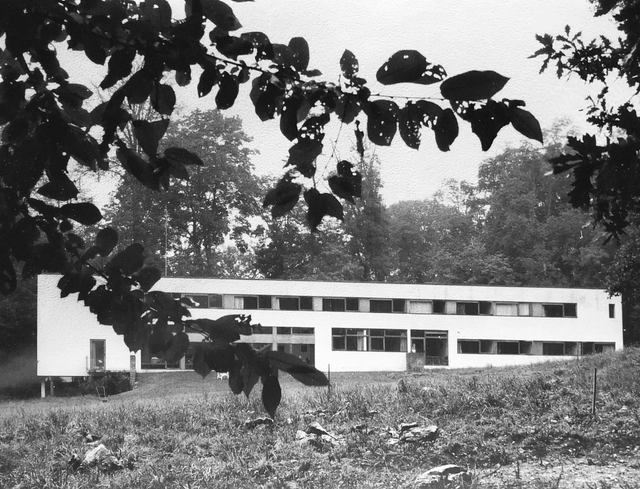
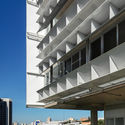
Exterior view of l’Eau Vive hospital, Soisy-sur-Seine, France, 1960s. Image Courtesy of Archives of Nicole Sonolet, collection of Christine de Bremond d’Ars
What would it mean to design buildings that exceed the economic accountings of liberal biopolitics, that instead offer an entirely different rationale for supporting health? In the years that Michel Foucault conceptualized the term biopolitics, he was part of a constellation of researchers and architects who developed care praxes that defined the value of life and its maintenance through a desire-based calculus. The welfare state institutions of architect Nicole Sonolet in particular—mental hospitals, public housing complexes, and new village typologies built mainly in postwar France and postcolonialAlgeria from the 1950s to the 1980s—were designed not only to support but to center the needs of people often excluded from design processes. Sonolet’s mental health centers for residents of Paris’s 13th arrondissement, in particular, were key projects for discovering a design practice tied to the provision of care for its own sake.
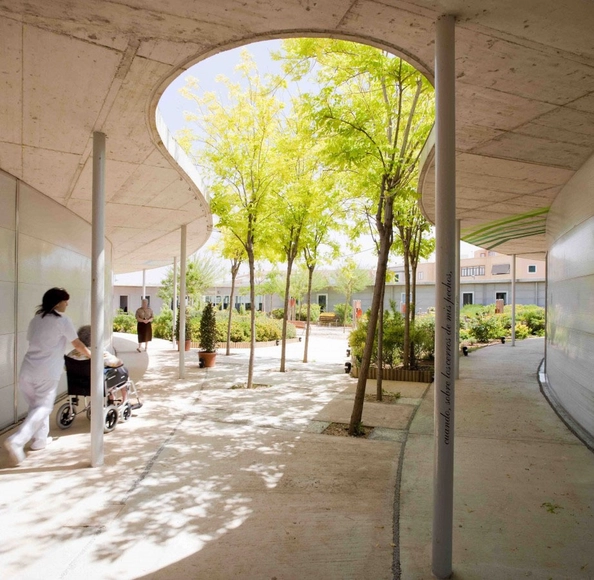
Santa Rita Geriatric Center / Manuel Ocaña. Image Courtesy of Manuel Ocaña
At a hospital, patients are always one conversation away from good or bad news. When not being rushed into treatment rooms, the sick are often left to feel stressed about their health. Healthcare workers have one of the most stressful jobs, with sudden changes in patient conditions. The general atmosphere in traditional hospitals seems tense and worrisome, and this has an adverse effect on patients’ well-being.
Artificial intelligence systems endeavor to replicate or mimic human intelligence by combining datasets with iterative processing algorithms to learn from patterns and experience. From Siri, Alexa and other smart assistants to conversational bots and email spam filters, what once seemed like a technology pulled from science fiction has become ubiquitous in our daily lives.
August 5th is National Health Day in Brazil. Our readers have already expressed their opinion on how psychology is essential to build healthy and pleasant spaces to live in, and for this reason, we decided to explore the impacts of the spatial experience on each person's well-being, improving quality of life and reducing mental stress. In other words, architecture not only contributes to physical health through ergonomics but also affects our emotional comfort.
https://www.archdaily.com/967003/architecture-and-health-how-spaces-can-impact-our-emotional-well-beingEquipe ArchDaily Brasil
In a Design and the City episode - a podcast by reSITE on how to make cities more livable – architect and founder of Doula x Design and co-founder of SHoP Architects Kim Holden discusses how rethinking and redesigning the ways birth is approached can change the outcomes of labor and birth experiences, and improve the qualities of life for both the babies and women giving birth to them. The interview explores how it is crucial to investigate the spaces where generations come into this world, just as we have been planning and building better cities for them to work and live in.
Around the world, the COVID-19 pandemic exposed the fact that some of the poorest people were hit the hardest by not only the impacts the virus had on public health but also the social and economic shockwaves that came as a result. And now, as we emerge on the other side yet also enter the second wave of restrictions around the globe, urban planners and government officials are beginning to realize that the pandemic has pulled back the curtains on another inequitable feature of cities- the proximity to public parks and spaces.
The COVID-19 pandemic has brought to the forefront an acute awareness of infection control in building design, both in public spaces as well as our personal spaces like homes and offices. Infection prevention and control experts consistently advise that improved hand hygiene is critical in maintaining a safe and sanitary environment. However, handwashing is not as simple as it would seem at first blush. The faucet itself is a major infection vector unless careful precautions are taken. The obvious answer to increasing the effectiveness of hand washing is by reducing the danger of being re-contaminated by the faucet through hands-free operation.
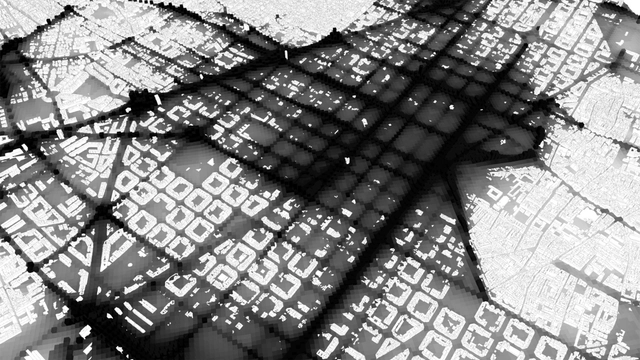
Cartography of Barcelona redrawn by air pollution. Image Courtesy of 300.000 Km/s
Catalonia in Venice - air/aria/aire, part of the Collateral Event of the Biennale Architettura 2021, is an exhibition curated by architect Olga Subirós, commissioned by the Institut Ramon Llull, with the participation of 300.000 Km/s, an urbanism studio in macro data-based strategic planning. Reflecting on the central theme of the Biennale “How will we live together?” the project investigates the role of architecture and urbanism within the context of the climate emergency and the public health crisis.
Things aren't going too well right now. Each new day seems to add to the uncertainty about the immediate and long-term impact of the Coronavirus pandemic. Whether you think that people are overreacting or it is truly a global health emergency, one fact is objectively true: Covid-19 has affected billions of lives: if not physically than economically and mentally.
Talieh Ghane researches the interaction between light and health at the California Lighting Technology Center. We talked about the biological vs. visual system of light, how to synchronize your circadian clock for better health, how light is like a drug, and why you shouldn’t be on your phone right before bed (guilty).
https://www.archdaily.com/917345/what-is-healthy-lightingSponsored Post
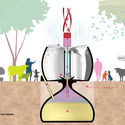
In support of World Toilet Day on November 19, SPARK Architects launched their prototype for a 3D printed toilet module titled, "Big Arse Toilet" alongside a slogan stating that "Sparks gives a sh*t." Though the pun-filled humor is definitely attention-grabbing, the project tackles serious issues of hygiene and sanitation as part of the UN initiative to eliminate open defecation by 2025. With the perpetuating cycle of malnutrition, disease, and poverty, poor sanitation is the leading cause in nearly a third of the deaths in low- and middle-income regions in several countries such as India.
Easily transportable, the toilet module converts human waste into biogas into electricity using a micro combined heat and power (CHP) unit. Essentially producing "free" energy, SPARK's proposal combats the issue of open defecation and uses the abundant natural waste in remote communities in Indian villages where there is low accessibility to electricity.
Did you know that tree-lined streets are proven to be beneficial to physical and mental health? So why not include them in health funding? The Nature Conservancy's new research demonstrates the number of reasons why this should be done.
https://www.archdaily.com/903855/cities-should-think-of-trees-as-public-health-infrastructureMayra Rosa
Last month Harvard University’s School of Public Health re-launched their Center for Climate, Health, and the Global Environment, introducing new partnerships and a new director for the institutional home of Dr. Joseph Allen’s Healthy Buildings initiative. With the stated mission of “improving the lives of all people, in all buildings, everywhere, every day,” the Healthy Buildings Team is leading research on how today’s built environments impact the health, productivity, and well-being of the people who inhabit them; as well as how future buildings can help us live healthier lives.
In the interest of defining their terms and presenting their research in a way that audiences outside academia can understand and incorporate into their work, the Healthy Buildings team have released an exhaustive list that details the simple foundations of making a building healthy.
The 9 foundations for healthy buildings are as follows:

















.jpg?1584702899&format=webp&width=640&height=580)