The Media Architecture Biennale 2023 (MAB23) takes place June 14-15 (online) and June 21-23 (in-person) in Toronto, Canada. The event, which features keynotes, roundtables, and awards, aims to offer a platform for communities of research and practice concerned with media and the built environment. MAB23 will bring together students, academics, and professionals from architecture, art, design, urban planning, media and communication, urban informatics, and public policy to share new ideas and shape this evolving field.
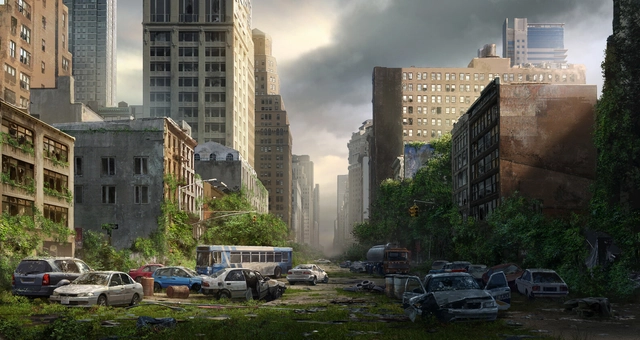
We’re all familiar with the plot of a movie that occurs in a city still standing in a post-apocalyptic era. The streets are empty, except for a few survivors who wander aimlessly, searching for signs of life. Buildings begin to crumble and rust away after years of neglect, public transportation sits idle, and overgrown weeds spring from the cracks in the unmanaged sidewalks and streets. The scene feels eerie because we can’t imagine letting our physical environment sit in decay. It seems impossible that our built environments where we live and work each day suddenly fall silent. It’s a city without a pulse.
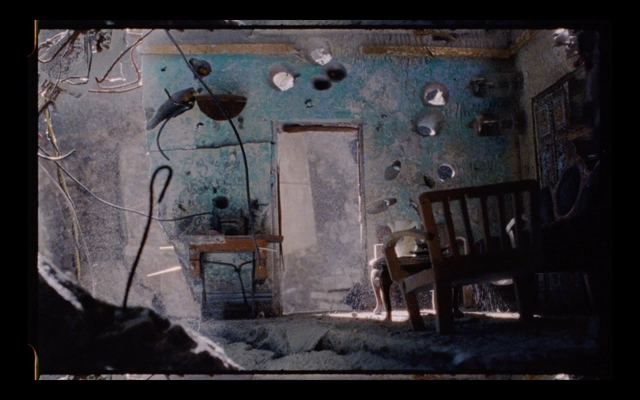
Abandoned house in "Touki Bouki". Image Courtesy of Janus Films
Simultaneously gripping, disconcerting, and chaotic, Djibril Diop Mambéty’s Touki Boukiis an exhilarating cinematic ride. The 1973 drama — the first full-length film by the Senegalese director — is the fantastical narration of a young couple in Dakar, eager to escape the Senegalese capital for the allure of Paris. It’s a character-driven film in many ways, primarily centered on the couple’s adventures, but it is also a subtle visual examination of the urbanism of post-independence Dakar, where the city and its architecture are essential fixtures in a surreal storyline.
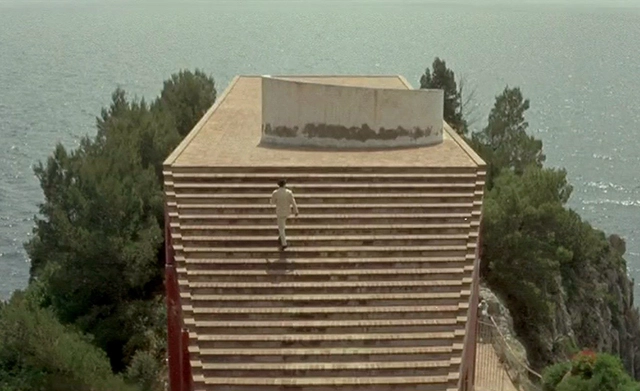
Villa Malaparte in Contempt. Image: movie screenshot
There are many ways to get to know a place. Ask a group of people who know Venice; chances are good that everyone has some mental image of the city and its canals. Once again, ask how many have already visited the Venetian capital. Few or no one may have done so. While traveling is a complete way to experience a place, it's not the only way - images of cities, areas and buildings are everywhere, from advertising to the arts, from Instagram to cinema, and they leave deep impressions on our memory and imagination.
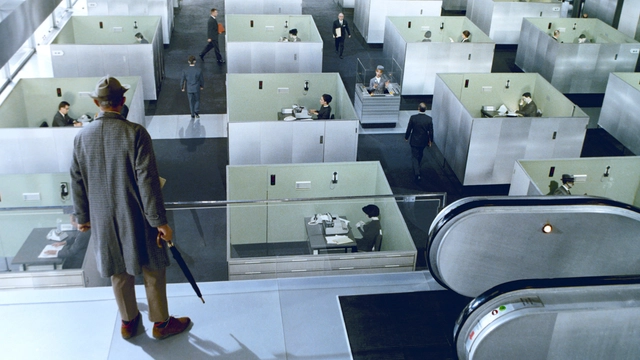
Playtime (Jacques Tati, 1967). Via film screenshot
Of all arts, there is one that is truly capable of embracing architecture, and that is the cinema. The ability to represent spaces, moving in the course of time, brings cinema closer to architecture in a way that goes beyond the limitations of painting, sculpture, music - for a long time considered to be the art closest to ours - and even of dance. Both in cinema and in architecture space is a key subject, and although they deal with it in different ways, they converge by providing a bodily - and not only visual - experience of the built environment.
After Yang is a science fiction film written, directed, and edited by Kogonada - a South Korean-born American filmmaker known for his video essays on audiovisual content analysis. The main plot of the film follows the story of a family trying to repair their damaged artificial intelligence in a post-apocalyptic world connected by technology and nature.
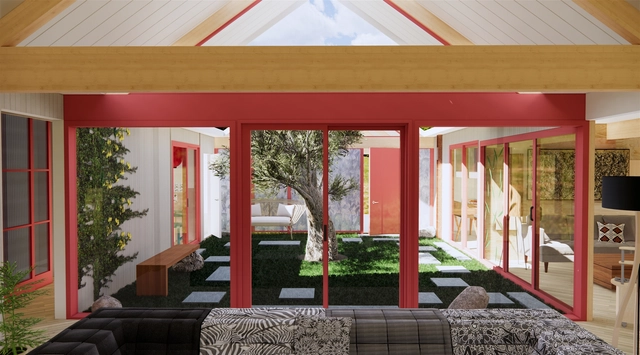
Alexandra Schaller, in charge of production design and the appearance of the sets, imagined a future that translates these considerations: From the family house that recovers the original design by Joseph Eichler of the 1960s, going through the importance of outdoor space and vegetation, to each of the materials that had to be non-disposable, renewable or biodegradable.
Cinemas mirror architecture. While the coronavirus pandemic shuttered theaters across the world for months, the industry is looking to the future as it aims to rethink the movie-going experience. As crowds flocked to the cinema after the 1918 pandemic, so too will the industry change shape again as it respond to new modes of watching films together.
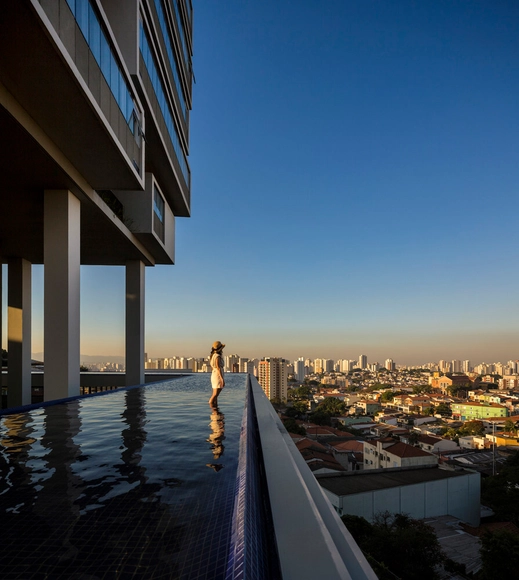
Fashion designer Paul Smith, British band Radiohead and Swedish film director Ingmar Bergman seem to have nothing in common, except for being constantly mentioned as major inspirations for São Paulo architect Isay Weinfeld. A multidisciplinary range of influences that says a lot about his personality and, accordingly , about his works.
Image: achassignon via VisualHunt / CC BY-SA. Assembly with image of John Cunniff via Visual Hunt / CC BY
Jean-Luc Godard, through his films, talks about architecture almost as easily as he talks about cinema itself. In honor of the nouvelle vague icon, who passed away today at the age of 91, we revisit How Architecture Speaks Through Cinema.
There are several ways of making films. Like Jean Renoir and Robert Bresson, who make music. Like Sergei Eisenstein, who paints. Like Stroheim, who wrote sound novels in silent days. Like Alain Resnais, who sculpts. And like Socrates, Rossellini I mean, who creates philosophy. The cinema, in other words, can be everything at once, both judge and litigant. — Jean-Luc Godard [1]
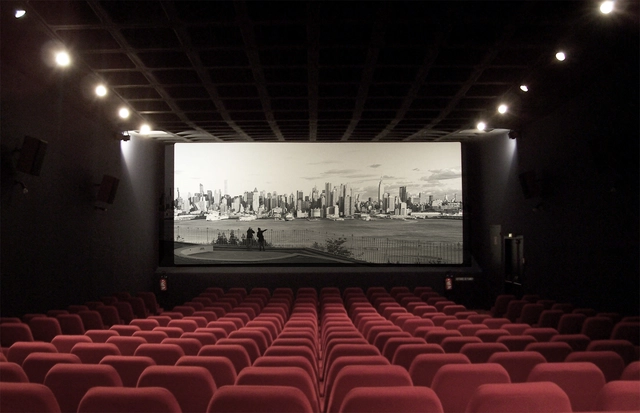
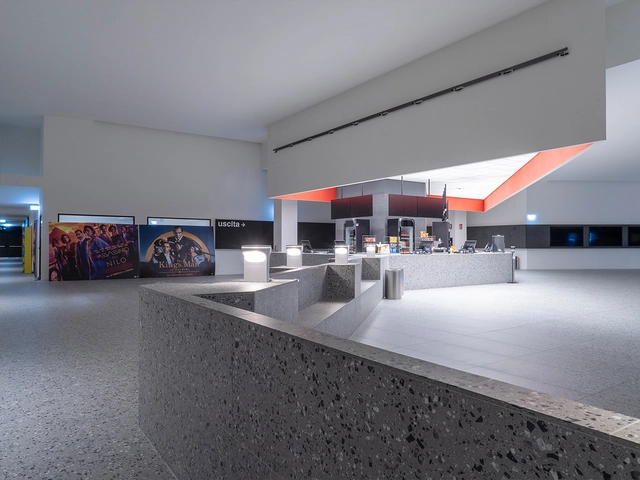
Arcadia Cinema / DW9. Image Courtesy of Iris Ceramica Group
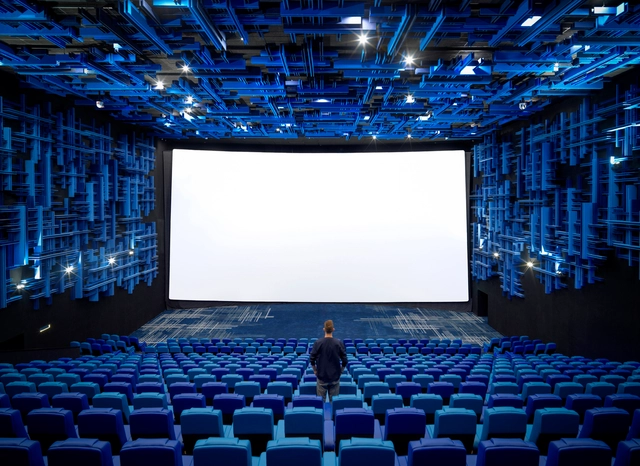
In the context of the pandemic, where several businesses were forced to close temporarily, movie theaters across the world were among the most affected. Fast forward more than two years later, and the lingering effects of COVID-19 are still present, marking a turning point in the traditional cinema experience. But even as attendance is still not close to pre-pandemic levels, certain segments of moviegoers are enjoying the benefits of the giant screen, comfortable seats, massive speaker systems and theater snacks.
One of the elements of most affinity between architecture and cinema is the scenographic project. The set designer, like the architect, starts from a concept to create spaces with a purpose. The architect designs spaces for living and the set designer designs spaces for storytelling. Many architects work with scenography because of the affinity between the activities.
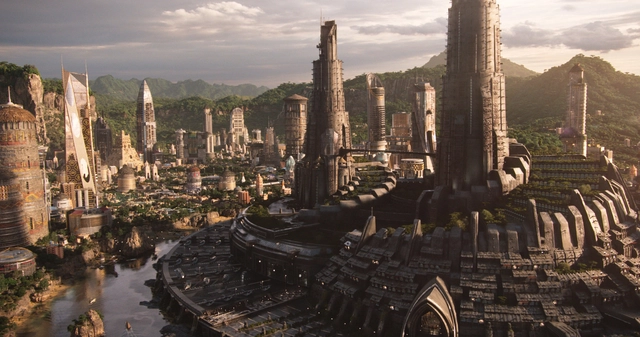
Storytelling is undoubtedly one of the oldest informative tools; a universal language that has transcended generations and cultures, and has been adapted into different media such as video games, theater, and film. Regardless of how old the narratives are, the success of these adaptations relies heavily on production - the visual and audible elements - and their ability to allow viewers to fully immerse themselves in the storyline. In this article, we explore the magical and captivating world of Marvel Cinematic Universe, and how architecture played an important role in contributing to the movies’ notorious storylines.
‘’In the background there is still invisible Japanese tradition’’, expresses Kisho Kurokawa, in an excerpt from the film ‘Kochuu’. He puts an emphasis on Japanese tradition, an architectural tradition that rejects symmetry despite the utilization of high-tech. He contemplates the Nakagin capsule tower (1972) a mixed-use residential and office tower located in Tokyo, Japan. The first of capsule architecture built for practical and permanent use.
Jesper Wachtmeister’s‘Kochuu’ is based upon the influence and origins of Modernist Japanese architecture. Through visions of the future, tradition and nature, it amplifies elements of Japanese tradition and its impact on Nordic design. The narrative tells us of how contemporary Japanese architects strive to unite the ways of modern man with old philosophies to create anew.
The stage is set in one of the most iconic “end of the world” movie scenes: Citizens of New York City are scrambling on top of taxis, quickly attempting to escape the slow-moving giant tsunami heading their way. In the rear-view mirror of a bus, a giant wave can be seen rushing up the narrow city grid. Searching for higher ground, the main characters, Sam and Laura, run up the famed stairs into the famed New York Public Library, and just as the revolving doors shut behind them, the pressure of the water smashes the windows, and water begins to rise. Without seeing it, we know that New York City and its iconic architecture will soon be destroyed.
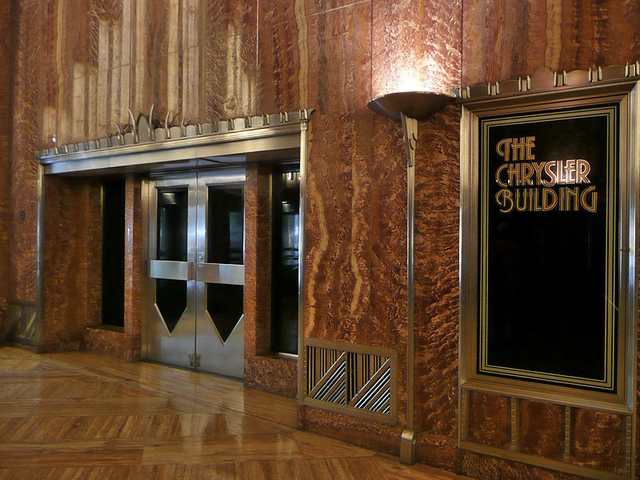
The Chrysler Building interior, Manhatten, New York . Image Courtesy of Dorff / Wikicommons CC BY-SA 3.0
Art Deco or Arts Décoratifs originated in the 1920's, following the Exposition Internationale des Arts Décoratifs et Industriels Modernes held in Paris (1925). However, it wasn’t until the 1930’s that the movement gained momentum across both Europe and the US, broadening Art Deco to cover all elements of decorative art including furniture, interior design, jewelry and architecture. Its popularity stems from its unique origins. Rather than a design movement driven by political or philosophical forces, it was created for the desire of glamorous and alluring change, a reflection of the golden age in Hollywood and a widespread economic boom.
Characterized by its decadence, rich application of color, and geometrical shapes, the movement is dramatically influenced by the discovery of the artifacts of ancient civilizations, and the introduction and admiration of the automobile. A movement heavily influenced by aspects in vogue it sought to create a form of luxury modernism, a step away from a more traditional architecture. It put an emphasis on handcrafted and individually designed elements, rarely to be mass produced.
Graduating with an architecture degree is often met with the expectations of working a 9-5 job at an office. However, the reality is that many fresh graduates are venturing into diversified careers and exploring fields such as architectural photography, writing, rendering, set design, and project management. In this Editor's Talk, ArchDaily's Founder and Editor in Chief, Director of Software Product Development, Managing Editors, and Social Media Editor share their experiences of graduating with a Bachelor's Degree in Architecture then finding themselves exploring different, yet very complimentary career paths post graduation, proving that there is a lot more to the architecture practice beyond designing built spaces.
Broadly speaking, the performing arts are all those disciplines that take place on a stage, although the main ones are dance, theatre and music. However, parades, religious processions, holiday celebrations and carnivals also have a clear scenic quality. That is why the stage space is so important not only for the presentations of these disciplines but also for carrying out a whole bodily and spatial process that is supported by the architecture.
Videos
Courtesy of A Broken House, The New Yorker Documentary directed by Jimmy Goldblum
“A Broken House” is a documentary directed by Jimmy Goldblum that highlights the story of Mohamad Hafez, a Syrian native that moved to the US on a single-entry visa to study architecture and was not able to return home. Facing his fate, he channeled his homesickness in his artwork, and started producing miniature sculptures of his hometown, in order to build the “Damascus of his memories”.
“If you can’t get home, why don’t you make home”. Telling the story of the human being that lived within, the architectural project gained a political dimension after the eruption of the Syrian civil war, portraying the extent of the destruction suffered by the city, humanizing refugees, and sharing their stories.























.jpg?1645602665 "ArchDaily Product Development Team. Image Courtesy of Soledad Sambiasi")



.jpg?1643867734&format=webp&width=640&height=580)


.jpg?1643867734)