1. ArchDaily
  2. Guggenheim

Guggenheim: The Latest Architecture and News

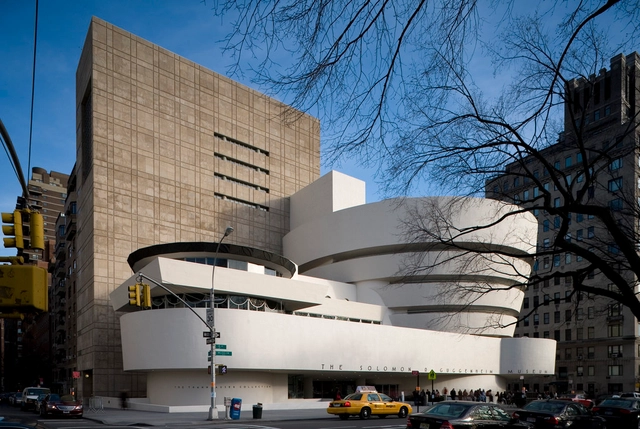
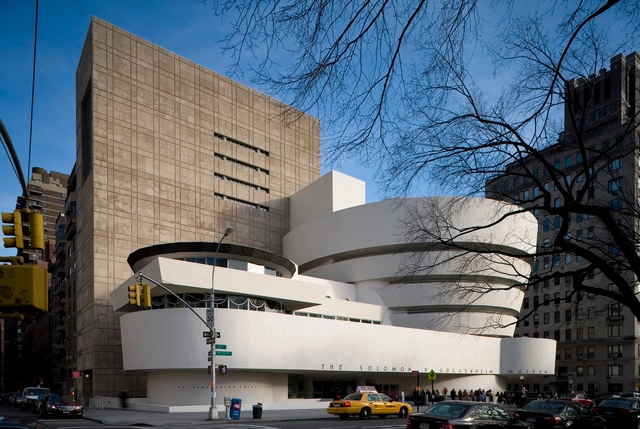
Gallery: Frank Lloyd Wright's Solomon R. Guggenheim Museum by Laurian Ghinitoiu

The Solomon R. Guggenheim Museum, which opened in 1959, was controversial for being “less a museum than it is a monument to Frank Lloyd Wright.” Although Wright intended to display paintings on the curved interior walls of the central open space, the concave walls made it unworkable. Instead, the central atrium became a place for procession and the uncovering of space through movement. The continuous ramp overlooking the atrium allows people to interact from different levels.

Photographer Laurian Ghinitoiu places people at the core of his photography which perhaps explains how, in this photoset of the Guggenheim Museum to mark Wright's 149th birthday, he captured the essence and vitality of the Guggenheim Museum. While some images depict the museum’s atrium as a place for passing-by, wandering or socializing, others grasp the growing influence of photography and self-representation on visitors’ experience. Some shots also show the building in its urban context with people involved in daily life activities.

Gallery: Frank Lloyd Wright's Solomon R. Guggenheim Museum by Laurian Ghinitoiu - Image 1 of 4Gallery: Frank Lloyd Wright's Solomon R. Guggenheim Museum by Laurian Ghinitoiu - Image 2 of 4Gallery: Frank Lloyd Wright's Solomon R. Guggenheim Museum by Laurian Ghinitoiu - Image 3 of 4Gallery: Frank Lloyd Wright's Solomon R. Guggenheim Museum by Laurian Ghinitoiu - Image 4 of 4Gallery: Frank Lloyd Wright's Solomon R. Guggenheim Museum by Laurian Ghinitoiu - More Images+ 25

Walk Inside: Google Cultural Institute Puts New York's Guggenheim On The Map

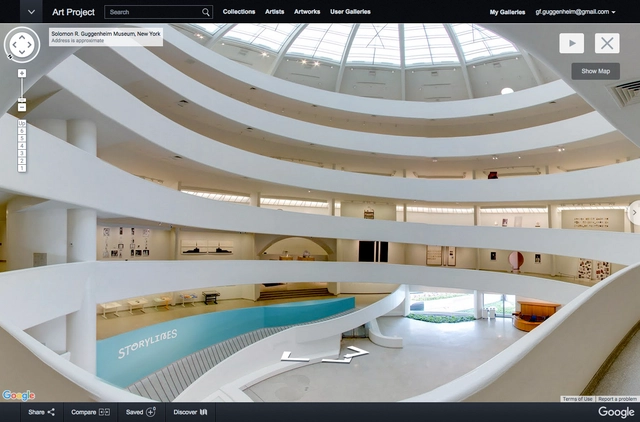
The Google Cultural Institute have teamed up with New York City's iconic Solomon R. Guggenheim Museum, designed by Frank Lloyd Wright and completed in 1959, to open its doors through Street View. Additionally, the Solomon R. Guggenheim Foundation has made over 120 artworks from its collection available for online viewing. "Using Street View technology, it will now be possible to tour the museum’s distinctive spiral ramps from anywhere online," the Foundation said.

Wikipedia Editathon: Women in Architecture

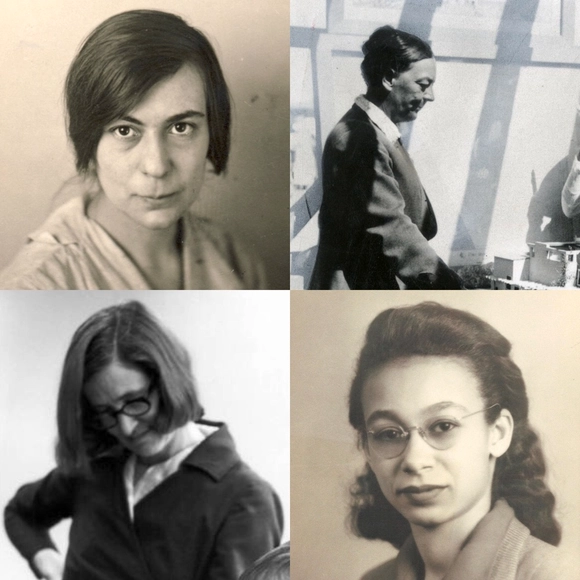
In conjunction with Archtober and New York Archives Week, the Guggenheim will host its third Wikipedia edit-a-thon—or, #guggathon—to enhance articles related to women in architecture on Wikipedia, the world’s largest source of free knowledge.

Moreau Kusunoki's 'Art in the City' Proposal Wins Guggenheim Helsinki Competition

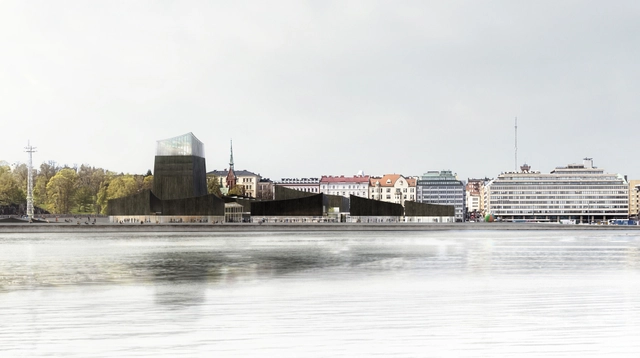
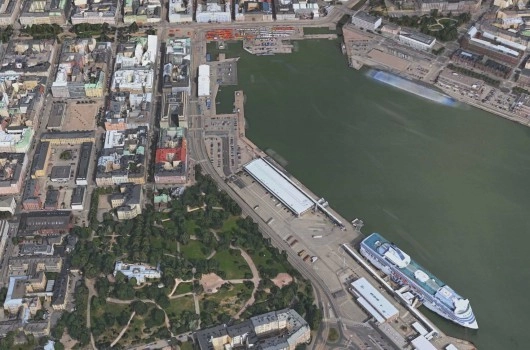
Moreau Kusunoki, based in Paris, have been announced as the winners of the Guggenheim Helsinki competition following a year of shortlisting, refining and deliberation. Their proposal—entitled Art in the City—"sums up the qualities the jury admired in the design" noted Mark Wigley, chair of the jury. He continued: "the waterfront, park, and nearby urban area all have a dialogue with the loose cluster of pavilions, with people and activities flowing between them. The design is imbued with a sense of community and animation that matches the ambitions of the brief to honor both the people of Finland and the creation of a more responsive museum of the future."

The announcement was made this morning in Helsinki by Richard Armstrong, Director of the Solomon R. Guggenheim Museum and Foundation. Also present was Professor Mark Wigley, chair of the jury and Dean Emeritus of Columbia GSAPP, Jussi Pajunen, Mayor of Helsinki, Ari Lahti, chairman of the Guggenheim Helsinki Supporting Foundation, and the architect team.

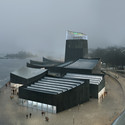
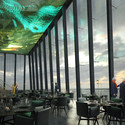
Moreau Kusunoki's 'Art in the City' Proposal Wins Guggenheim Helsinki Competition - Image 7 of 4Moreau Kusunoki's 'Art in the City' Proposal Wins Guggenheim Helsinki Competition - Image 8 of 4Moreau Kusunoki's 'Art in the City' Proposal Wins Guggenheim Helsinki Competition - Image 5 of 4Moreau Kusunoki's 'Art in the City' Proposal Wins Guggenheim Helsinki Competition - Image 9 of 4Moreau Kusunoki's 'Art in the City' Proposal Wins Guggenheim Helsinki Competition - More Images+ 11

6 Final Designs Unveiled for Guggenheim Helsinki

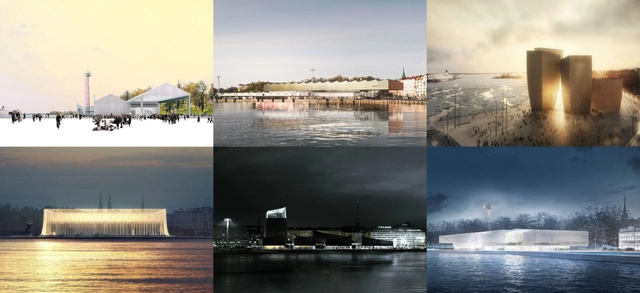
Now for the first time, Guggenheim has unveiled the six fully developed designs competing to become Guggenheim Helsinki. Selected from 1,715 entries in world's the most popular architectural competition, the remaining finalists have spent the past five months refining their designs after being shortlisted by an independent 11-member jury, of which includes Studio Gang's Jeanne Gang and former Columbia University dean Mark Wigley.

The release foreshadows the April 25 opening of Guggenheim Helsinki Now: Six Finalist Designs Unveiled, a free exhibition that will open the projects up to public critique. A winner will be announced on June 23.

All 6 detailed proposals, after the break.

Michael Sorkin's 'The Next Helsinki' Competition Attracts Over 200 Entries

The organisers behind The Next Helsinki, a competition masterminded by architect and critic Michael Sorkin, have announced that they have received over 200 international entries. Launched as an alternative to the controversial Guggenheim Helsinki project, the competition called upon architects, urbanists, artists, and environmentalists to imagine how Helsinki and the South Harbour site allotted to the proposed museum could be transformed for the maximum benefit of the city’s residents and visitors.

Michael Sorkin On The Guggenheim, Museum Culture, and "The Next Helsinki" Competition

Subscriber Access | 

Aside from attracting a huge level of media interest, the record-breaking competition to design the Guggenheim Museum's planned outpost in Helsinki also generated a significant level of criticism - not least from Michael Sorkin and his collaborators, who launched a counter-competition seeking alternative suggestions for how the site could be used. In this article, originally published on Metropolis Magazine as "'We Mean to Be Provocateurs': Michael Sorkin on the Next Helsinki Competition," Zachary Edelson interviews Sorkin on his reaction to the Guggenheim's shortlist, his hopes for his own competition, and the critical role that museums play in the worlds of both art and architecture.

The reverberations of the Bilbao Effect, where a prize museum infuses a region with prosperity and global cache, have concentrated on an unlikely city: the Finnish capital of Helsinki.

The Solomon R. Guggenheim Foundation is famous for its Fifth Avenue museum, but its 1997 Frank Gehry-designed Bilbao outpost famously catapulted its small Basque host city to new levels of international renown. The city’s tourism revenue quickly helped recoup the museum’s extensive costs: $100 million for design and construction, subsidies towards a $12 million annual budget, $50 million for an acquisitions fund, and $20 million to the Guggenheim for its name, curatorial services, and the use of parts of its collection. Within three years, visitors’ spending had garnered $110 million and by 2013 more than 1 million had entered the gleaming metallic structure. Many have tried to replicate Bilbao’s success but opposition against such massive expenditures always looms. In this case, it has manifested in a rival competition led by New York-based architect and writer Michael Sorkin and titled The Next Helsinki.

Frank Gehry Tells the Story Behind Guggenheim Abu Dhabi

In just three short years, Frank Gehry’s 450,000-square-foot Guggenheim Abu Dhabi will open. More than 12 times the size of Frank Lloyd Wright’s Guggenheim New York, the expansive $800 million museum will showcase 1960s art from around the world within an asymmetrical mountain of plaster blocks and self-cooling translucent cones. Anticipating its completion, the New York Times sat down with Gehry to hear the story behind the building’s design. Watch the full interview with Gehry, here.

32 "Discarded" Helsinki Guggenheim Proposals You Should Know About

32 "Discarded" Helsinki Guggenheim Proposals You Should Know About - Image 141 of 4

The search for a design for Helsinki’s new Guggenheim Museum is well under way. Over a thousand entrants submitted anonymous proposals for the harbor-side museum, and though six finalists have now been chosen, the incredible wealth of talent and effort present in the submissions is hard to ignore. We celebrate that talent here, showcasing 32 great designs-that-could-have-been for the Helsinki Guggenheim. Learn more about all of them, after the break!

Share Your Guggenheim Helsinki Proposals with ArchDaily!

With 1,715 entries submitted, the Guggenheim Helsinki Competition has become the most popular architectural competition in history. Only six proposals have made it through to the final round, however we believe there is something to be learned from the hundreds of proposals that didn't make the cut. Therefore, if you participated in the Guggenheim Helsinki Competition and would like ArchDaily’s team of architects and editors to review your proposal for publication, we ask you to submit your proposal here (under "Submit an event, competition, award, news") by Wednesday, December 10. All proposals submitted after this deadline will not be considered. Take a look after the break for the required format for submitting project materials.

Guggenheim Helsinki Design Competition: A Parametric Analysis

Subscriber Access | 

The following analysis of the Helsinki Guggenheim competition entries was contributed by Federico Reyneri, partner at LPzR associates architects, and his research team.

Architects have always pushed the limit, often experimenting with forms and technologies unavailable in their time. In the last 20 years, we experienced a small revolution in thinking about spaces and embracing complexity, as computers started to show their real power. Since Gehry’s Guggenheim came to life in the mid nineties, nothing has been the same: free forms emerge everywhere from the dreamland to reality (often becoming someone else’s nightmare). Before this computer technology, except for the realm of the mind and clay modeling, real control over complexity through technical drawings was too hard a game for us ordinary mortals but eventually, in the last 10 years or so more powerful and cheaper computers and even cheaper software, capable of astonishing parametric-generated design elements, came out. Since then, new generations of designers have started to set free mind-blowing ideas, showing the world amazing computer generated pictures. Some architects even started to build them.

But how widespread is parametric design technology? How does it influence architecture worldwide? We started to analyse the Guggenheim Helsinki Design Competition, the largest architectural design competition in world history.

6 Finalists Revealed in Guggenheim Helsinki Competition

The Guggenheim has announced the finalists in the competition to design Guggenheim Helsinki, whittling down the entrants from a record-breaking 1,715 submissions to just six. Representing both emerging and established practices with offices in seven countries, the shortlisted entries show a variety of responses to the challenge of creating a world-class museum.

The six finalists are:

Read on after the break to see all six designs in detail, as well as the jury's comments on each.

Get to Grips with Guggenheim Helsinki's Record-Breaking Competition with this Infographic Video

By now, when the design competition for the Guggenheim Helsinki is mentioned, one number probably comes to mind: 1,715, the record-breaking number of submissions which the competition received. But how can this number be put into perspective? Why, with more numbers of course. Take 5,769 for example, which is the total height in meters of all the A1 presentation boards arranged vertically. Or take 18,336,780, the estimated value in Euros of all the work submitted.

Guggenheim Creates New Curatorial Position for Architecture and Digital Initiatives

Architect and scholar Troy Conrad Therrien has been appointed as the Guggenheim's new Curator of Architecture and Digital Initiatives. Therrien will now contribute to the development of the museum’s engagement with architecture, design, technology, and urban studies, in addition to providing leadership on select new projects under the direction of the Chief Curator and the Director’s Office.

“Advancing innovative programming that relates to architecture, technology, and urban studies, particularly on a global stage, is a priority for the Guggenheim,” Richard Armstrong, director of the Guggenheim stated. “Troy’s impressive and dynamic background spanning academia, architecture, and computer science should expand our forward-looking curatorial team.” Read the complete press release, here.

Twitter Reacts to 1,715 Guggenheim Designs

The news that every single one of the 1,715 designs for the future Guggenheim Museum in Helsinki have been released via a new competition website was understandably something of a media storm earlier this week. As the largest ever set of proposals to be simultaneously released to the public, how could anyone possibly come to terms with the sheer number and quality of the designs - let alone all the other issues which the proposals shed light on?

In this instance, the answer to that question is simple: get help. Guggenheim Helsinki will arguably go down in history as the prototypical competition for the social media age, not just for releasing the designs to the public but for their platform which enables people to select favorites, and compile and share shortlists. In the days since the website launched, Twitter users have risen to the challenge. See what some of them had to say after the break.

See All 1,715 Entries to the Guggenheim Helsinki Competition Online

See All 1,715 Entries to the Guggenheim Helsinki Competition Online - Featured Image
GH-7128234610. Image Courtesy of Malcolm Reading Consultants

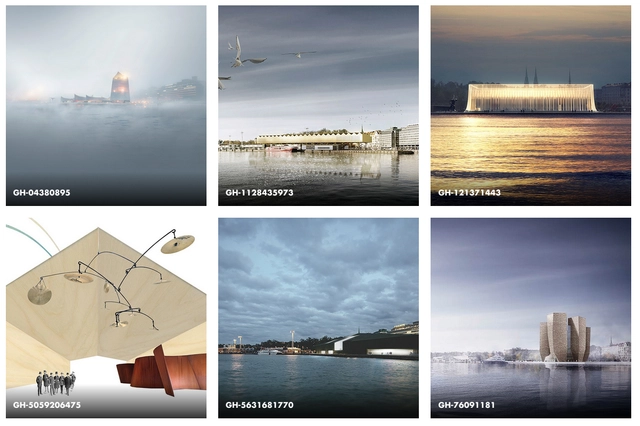
The competition for the new Guggenheim Museum in Helsinki closed last month, becoming the most popular architectural competition in history with 1,715 entries. Now, competition organizers Malcolm Reading Consultants have made every single one available to view online, with each anonymous proposal presented in a series of two images, and a short description fro the architects. "Since its inception, this competition has been organized to be welcoming, inclusive, and transparent, and the gallery presents a singular opportunity for the public to explore and consider the broad expanse of entries," says Richard Armstrong, Director of the Solomon R. Guggenheim Museum and Foundation.

Competition organizer Malcolm Reading added: "For anyone interested in design, the gallery is a tremendous resource that offers rare insight into the design process and further illustrates how the vision for a Guggenheim Helsinki... [has] captured the imagination of architects around the world."

And indeed, the website does provide a tremendous tool: with such a huge volume of entries, the database and its associated tagging system offer an interesting way to probe the architectural zeitgeist: for example, it seems 'curved' buildings are almost twice as popular as 'straight' buildings; and 'opaque' buildings are still unpopular, being outpaced by 'transparent' buildings by almost five to one, despite the traditionally opaque museum typology.

But when it comes to architectural quality, where do you even begin with 1,715 proposals? The competition's website has that covered too, with a favorites button, a six-building shortlist tool and a search-by-registration tool. ArchDaily is here to help too: after the break, we've hand-picked 50 of the most exciting, unusual, interesting and simply absurd proposals for you to start talking about.

See All 1,715 Entries to the Guggenheim Helsinki Competition Online - Image 1 of 4See All 1,715 Entries to the Guggenheim Helsinki Competition Online - Image 2 of 4See All 1,715 Entries to the Guggenheim Helsinki Competition Online - Image 3 of 4See All 1,715 Entries to the Guggenheim Helsinki Competition Online - Image 4 of 4See All 1,715 Entries to the Guggenheim Helsinki Competition Online - Image 5 of 4See All 1,715 Entries to the Guggenheim Helsinki Competition Online - Image 6 of 4See All 1,715 Entries to the Guggenheim Helsinki Competition Online - Image 7 of 4See All 1,715 Entries to the Guggenheim Helsinki Competition Online - Image 8 of 4See All 1,715 Entries to the Guggenheim Helsinki Competition Online - More Images+ 95

Guggenheim Considers Competition for Second NYC Location

The Solomon R. Guggenheim Museum is planning to construct a second location in New York City. As reported on the Art Newspaper, the expansion project, known as the “Collection Center,” aims to “consolidate its staff and art storage into one efficient, multi-use building with a dynamic public programming component.” The news broke with the release of a curatorial job position, seeking personnel to assist in the center’s planning and a possible architecture competition that will ensure the “Guggenheim’s reputation for being a visionary architectural patron” is preserved. Meanwhile, the Guggenheim is expected to narrow its selection to six for its new Helsinki location in November.

Guggenheim Helsinki To Launch Search for Architect

The Art Newspaper reports that the Guggenheim will launch an international competition on June 4th to find an architect to design a satellite in Helsinki, Finland focused on "Nordic and international architecture and design, and their connection contemporary art."