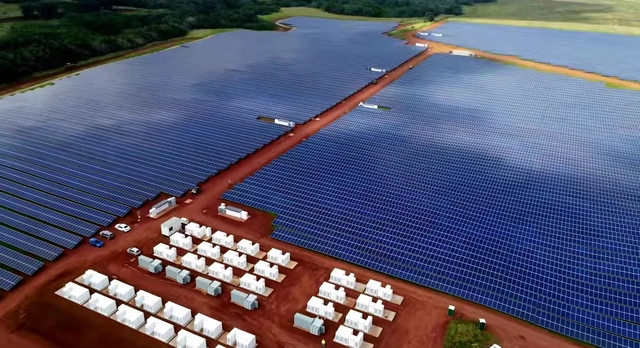
Tesla has completed a massive, 55,000-panel solar farm on the Hawaiian island of Kauai that will allow them to experiment with medium-term energy storage at a utility scale. Hooked up to the farm are 272 of the company’s lithium Powerpacks, which are capable of storing of combined 52 megawatt-hours of power.
No one puts solar panels on their house because they’re sexy—at least, not yet.
Jon Gardzelewski, an architect and associate lecturer at the University of Wyoming in the Building Energy Research Group (UW-BERG), wants to change that. He believes the fact that solar panels are usually an afterthought to the design of a building is a big barrier to integrating them into a critical mass of houses and buildings.
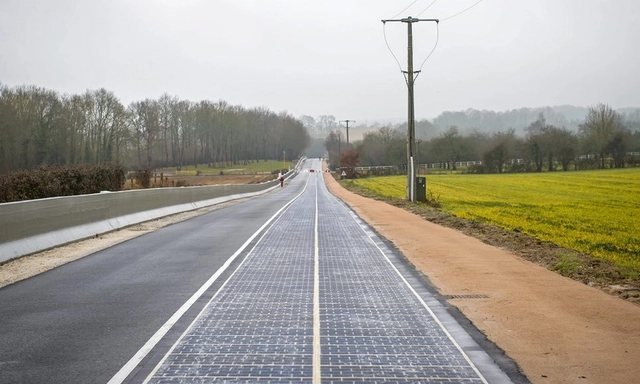
The world’s first solar panel road has officially opened in a small village in Normandy, France.
Built in the small village of Tourouvre-au-Perche, the 1 kilometer route, dubbed the “Wattway,” is covered in 2,800 square meters of photovoltaic panels. It is designed to be used by up to 2,000 motorists per day, while providing an average of 767 kilowatt-hours (kWh) per day, enough energy to power all of the street lighting in the 3,400-resident village.
Elon Musk has revealed his company Tesla’s latest world-changing innovation: a solar roof system so fully integrated into a home’s architecture as to be indistinguishable from a traditional roof.
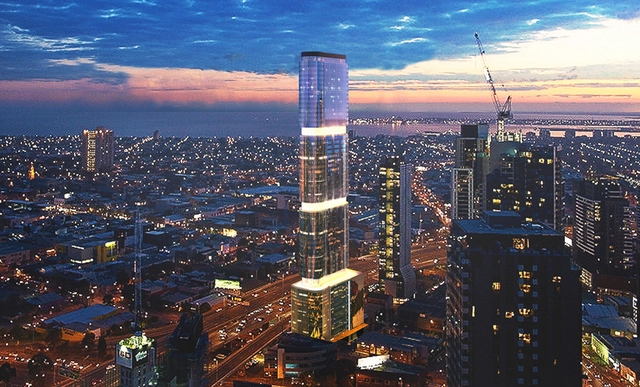
Peddle Thorp Architects have submitted their proposal for the Moray Street Residential Tower in Melbourne for approval. At 1173.5 square meters, Sol Invictus is wrapped entirely in solar panels, attaining 10 times more solar surface area than a traditional roof covering. The facade can achieve up to 5000 square meters of solar panel array and is connected to a battery storage system.
London-based design firm Caventou has designed a series of “stained glass” everyday objects that turn daylight into electricity, even indoors.
Integrated with solar cells, Current Table and Current Window are both independent, intelligent power sources that function normally as household items.
Solar energy is considered by many to be the future of electricity worldwide. Cities from Houston to Mumbai are embracing massive rooftop and rural solar infrastructure, a largely standardized system of fixed panels positioned to optimize sun intake at peak times. Only the most sophisticated adjustable panels which track the sun, however, are capable of absorbing the maximum amount of daylight allowed by the technology, meaning that the average immovable panel loses a significant amount of available energy.
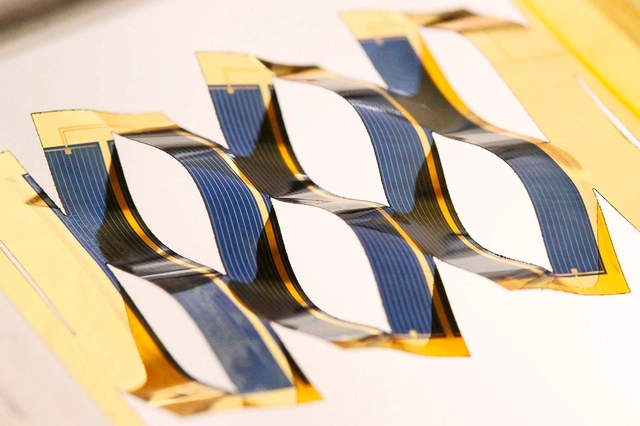
Researchers at the University of Michigan sought to develop a solar energy system that could absorb the most daylight possible while reducing the carbon footprint from production of the panels themselves. The results are surprisingly beautiful: through the application of the ancient Japanese art of Kirigami, a variation of Origami, the researchers were able to capture up to 40 percent more sunlight than traditional panels.
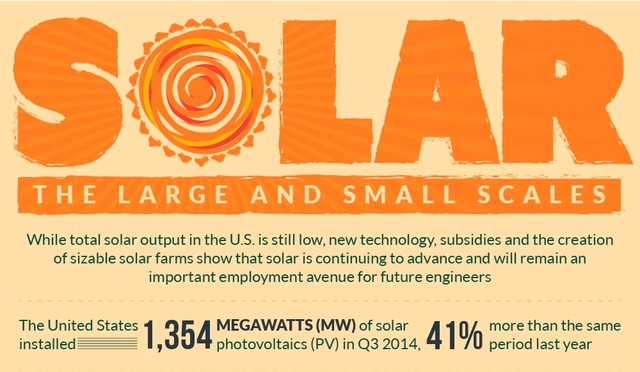
Texas and clean energy are hardly considered synonymous. However, as uncovered by a recent article in the Wall Street Journal, Texas has emerged as an unexpected leader in solar power, with $1 billion now being invested in solar energy infrastructure with an aim to produce up to 12,500 megawatts of solar electricity by 2029. To mark this important moment in US energy production, the New Jersey Institute of Technology has produced this infographic revealing the benefits (and drawbacks) of solar energy for the average American consumer, including everything from the history of solar energy to incentives available for solar systems nationwide. Read on to view the infographic in full.
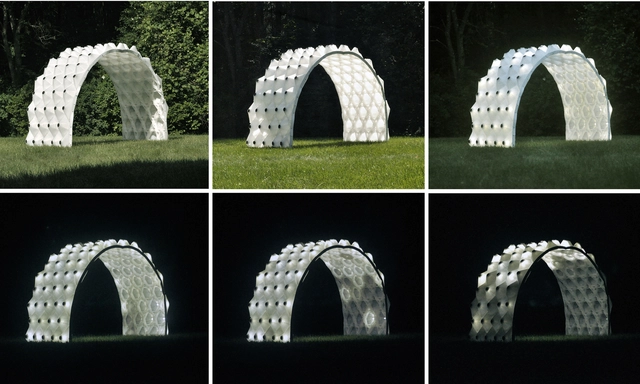
The Solar Bytes pavilion, designed by assistant professor at Kent State UniversityBrian Peters, is a temporary structure which highlights the potential of new techniques available to architecture: robotic arms, 3D printing, smart technologies such as lighting sensors, and solar energy.
Leveraging the strength and range of motion of a robotic arm, the pavilion was printed in three dimensions with an experimental extruder, resulting in a structure composed of 94 unique modules that capture energy during the day, and shine at night. After their initial function, the plastic modules making up the pavilion will be completely crushed and reused in a new structure.
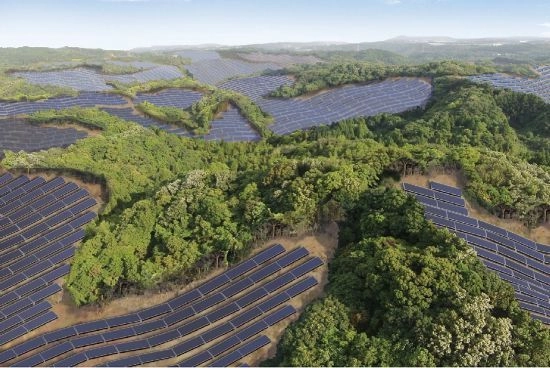
With a goal to double the amount of its renewable energy power sources by 2030, Japan has begun to transform abandoned golf courses into massive solar energy plants. As Quartz reports, Kyocera, a company known for its floating solar plants, has started construction on a 23-megawatt solar plant on an old golf course in the Kyoto prefecture (scheduled to open in 2017). The company also plans to break ground on a similar, 92-megawatt plant in the Kagoshima prefecture next year. Pacifico Energy is also jumping on the trend; with the help of GE Energy Financial Services, the company is overseeing two solar plant golf course projects in the Okayama prefecture. The idea is spreading too; plans to transform gold courses into solar fields are underway in New York, Minnesota and other US states as well.
The winner of a competition for a mixed-use building scheme, London-based Kamvari Architects has unveiled the design for Zartosht, a 300,000 square-foot retail and office building in Tehran, Iran. The building's design is based largely on local cultural contexts, like the region’s reputation for renowned fabric and textile shops, and environmentalism, particularly with respect to solar energy.
KAMJZ have unveiled their proposal for the UIA’s MOLEWA (Mount Lu Estate of World Architecture) competition, which tasked participants with designing several cultural and commercial complexes near one of the world’s largest flower theme parks in Ruichang, China. Titled Ruichang Flower Market, KAMJZ's design contemplates a series of shopping streets with high-end, as well as more vernacular shopping spaces, in particular a specialty area carrying flowers grown in the neighboring Flower Theme Park, traditional crafts, and souvenirs.
The New YorkLowline, a project which was first announced in 2011 and was rekindled last year, have now launched a Kickstarter campaign in order to make their dream of using solar technology to "transform an historic trolley terminal into the world's first underground park" closer to a reality. Their proposal, which seeks to unlock the potential of underused subterranean urban spaces, would see the creation of a living, green public space built beneath the streets of New York City. They are currently seeking funding to build a long-term solar device testing laboratory and public exhibition in order to test and present their designs.
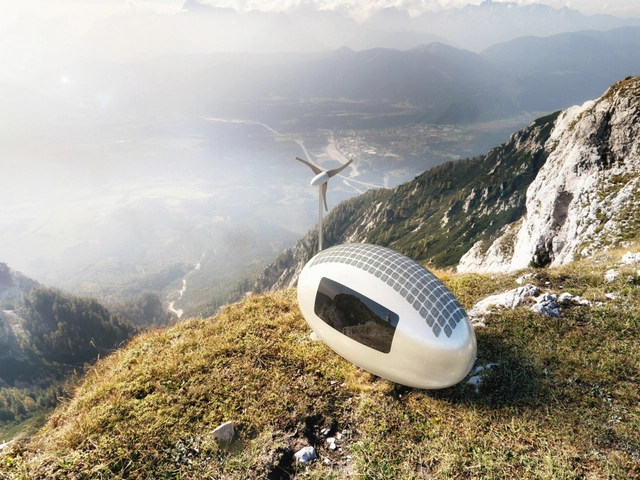
Living off the grid just got a little bit easier, thanks to Nice Architects’Ecocapsule, a self-sufficient, portable pod that is powered by solar and wind energy. Unveiled at the Pioneers Festival in Vienna, the micro-home’s spherical shape is designed to maximize the collection of rainwater and minimize energy loss.
The Ecocapsule includes a 9,744 watt-hour battery, which is charged by a built-in 750-watt wind turbine, and 2.6 square meters of solar panels. The energy system can support someone living off the grid for about a year, depending on the location, according to the architects. The unit also contains a built-in kitchenette with running water, a flushing toilet and hot water.
Learn more about the Ecocapsule and view images after the break.
The world's energy infrastructure may soon undergo significant change; Tesla Motors recently unveiled the Powerwall, a compact, lithium-ion battery pack that will allow residents to autonomously consume energy by drawing from their own sun-powered reserve. For just $3,500, you can purchase an attractive, wall-mounted battery capable of storing up to 10 kilowatt-hours of energy - about a third of what the average US household uses daily. Beyond this, the company will also be offering scalable Powerpacks to businesses and utility companies that will allow limitless storage. Powerwalls will go out for delivery this summer.
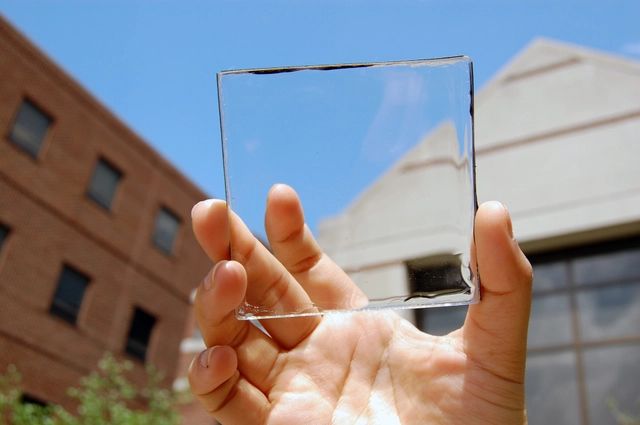
Solar harvesting systems don’t need to be glaringly obvious. In fact, now they can even be invisible, thanks to researchers at Michigan State University (MSU) who have developed a transparent luminescent solar concentrator (LSC) that can be applied to windows or anything else with a clear surface.
LSC technology is nothing new, but the transparent aspect is. Previous attempts yielded inefficient results with brightly colored materials, and as researcher Richard Lunt, an assistant professor of chemical engineering and materials science at MSU, puts it, “No one wants to sit behind colored glass.” To learn how Lunt and the rest of the research team achieved transparency, keep reading after the break.
Mapdwell announced today the unveiling of Mapdwell Solar System for the Washington, D.C. The MIT-born project has formed an alliance with the District Department of the Environment (DDOE) to provide its state-of-the-art rooftop solar resource to the U.S. capital.
DDOE was the first of several organizations to partner with Mapdwell after the platform was introduced in Cambridge, Massachusetts. The District’s map comes only seven months after the initial rollout of Solar System, and constitutes the first step in Mapdwell’s expansion in the United States and abroad.
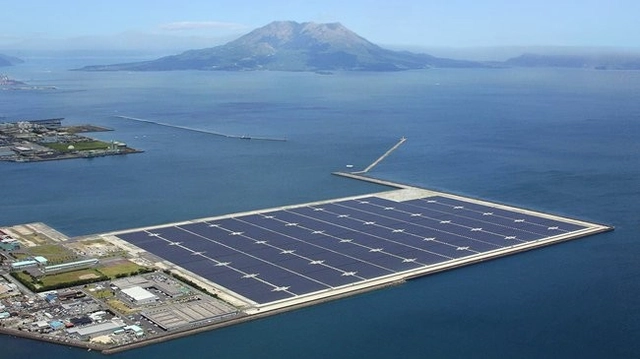
Solar panels are often an added bonus in design, becoming a means to an end. But why shouldn't they be the star of the show? A recent article in Metropolis Magazine shows off the Kagoshima Nanatsujima Mega Solar Power Plant, the largest solar facility in Japan. A symbolic response to the 2011 Fukushima nuclear disaster, the power plant is but one project in Japan's transition into one of the fastest growing solar markets in the world. Check out the full story here.






.jpg?1477928406 "\"Textured\" Style. Image © Tesla. Via the Verge")














.jpg?1437157057&format=webp&width=640&height=580)