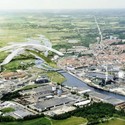
The French Rugby Federation (FFR) recently announced they will use the proposal by Populous and Ateliers 2/3/4/ for the design of the Grand Stade. After several months of discussions with three competing groups, the FFR has made its choice of designers and has issued the first computer-rendered images. The FFR Grand Stade will be much more than a stadium; the 82,000 capacity venue will become the ‘national stadium of rugby’. It will host all the French rugby home matches, and also accommodate conventions, shows and a broad range of sporting events thanks to its multi-purpose design. More images and architects’ description after the break.
NBBJ has shared with us their latest design in sports architecture, a multifunctional industrial sports complex for the residents of Suzhou, China. Designed as a community asset, the cultural sports hub will include a commercial center, aquatics facility, gymnasium, arena, professional sports stadium and more. All facilities will be integrated within a lush “Sports Garden” that features an abundance of pedestrian walkways, gardens and sport fields.
Three years have passed since a tremendous earthquake devastated Haiti. The long reconstruction process includes the construction of the country’s first stadium to be completed this year. Partners of Project Phoenix have created plans for Phoenix Stadium, a massive world-class professional soccer stadium soon to be located in Cite Soleil, Haiti. This project developed as a result of the 2012 Clinton Global Initiative when collaboration began between Morad Fareed of Delos and Boby Duval of L’Athletique D’Haiti. The vision is to create a world-class stadium for soccer games as well as many other community functions.
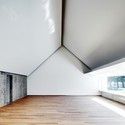
In search of the architectural and spatial form for the designed sports hall in Białystok, Studio EL, through their investigation of applied form typologies used in sports facilities, decided to use the coating system. This type of design is characterized by freshness, terseness and coherence in form and in contents of a function. The design consists of two-curvature, two-layered, steel space frames which will cover the space of the sports hall and will be based on the double buttresses located in its ambit. More images and architects’ description after the break.
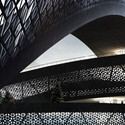
Wilmotte & Associés recently won the competition to design the 2018 FIFA World Cup Stadium in Kaliningra, Russia. Their design features an urban facade that wraps the stadium, consisting of a series of orthogonal screens that respond to the surrounding urban context. The project will be constructed from a primary steel structure, but the upper tier of the stadium will be temporary. The stadium has been designed so that after the tournament completes in 2018, the stands can be dismantled and the upper canopy can be removed. Construction of the 45,000 seat football stadium will begin in 2014. More images and architects’ description after the break.
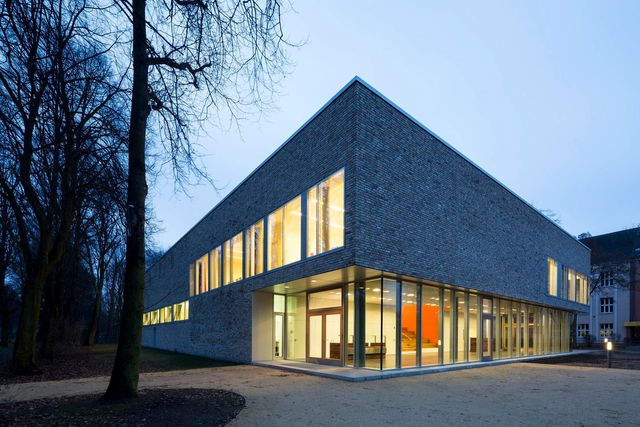
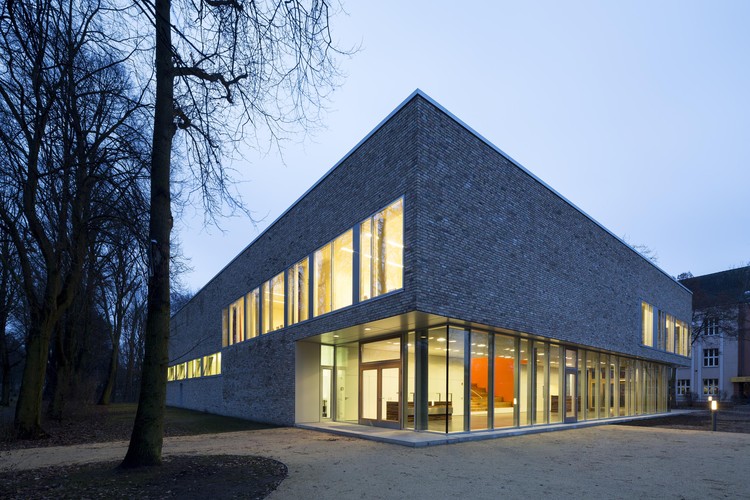
The winning proposal for the multi-sports complex in the city of Antony, France responds to the strong political will of a new urban ambition for the neighborhood. The context is heterogeneous linear collective housing on one side and unique botanical heritage of the Park on the other. Designed by Archi5 + Tecnova Architecture, this project includes a theme for each function including gathering, meeting, sports activities, and events. This becomes evident in all aspects of the building at all levels. More images and architects’ description after the break.
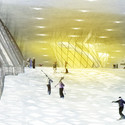
As we shared with you earlier last month, Danish architectural firm, CEBRA, in partnership with Ski Travel Agency Danski, is working on a new project of epic proportions: the world's largest Skidome. Skidome Denmark will be shaped rather like a snow-flake, with three 700m, criss-crossing arches (the tallest one reaching 110 m high). While a structure that size is hard to wrap one's head around, this cool new video gives a great idea of the Skidome's awesome scale.
More info and images of the World's Largest Skidome, after the break...
The Golden State Warriors recently announced that Snøhetta and AECOM have been selected as the architecture team to design the Warriors’ new sports and entertainment complex on the San Francisco waterfront. Currently in the final stages of the agreement, the new stadium will be a true centerpiece in hosting the Bay Area’s NBA basketball team, as well as provide a great venue concerts, cultural events and conventions, which are all prominent events the city currently cannot accommodate. More images of the architects’ design can be viewed after the break.